
Blog categories

Weekly newsletter
No spam. Just the latest releases and tips, interesting articles, and exclusive interviews in your inbox every week.
Latest from the blog
2025 Cybersecurity Report: Exposes the Dark-Web Economy Behind Brand Exploitation
Posted on: 04 Nov 2025 | Author: Foresiet
Introduction
The digital battleground of 2025 Cybersecurity Report has made one thing crystal clear: cyber-threats no longer behave like isolated incidents. They evolve, scale and exploit trust in ways that ripple across businesses and society. As the firm behind Foresiet collected in its latest intelligence, emerging and maturing attacks will shape a far more challenging threat landscape in 2026. By being proactive — leveraging stolen credentials detection, dark web surveillance, digital threat scoring, and brand protection strategies — companies can avoid being blindsided. In this blog we’ll explore the upcoming risks, the driving trends, the high-risk industries and how to prepare, so your organisation can tip the odds in its favour.
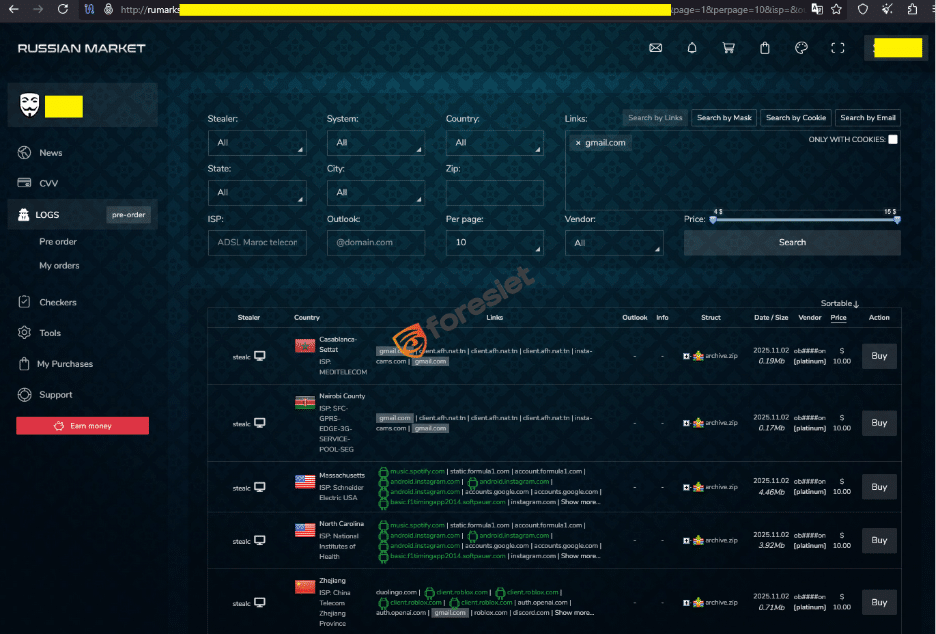
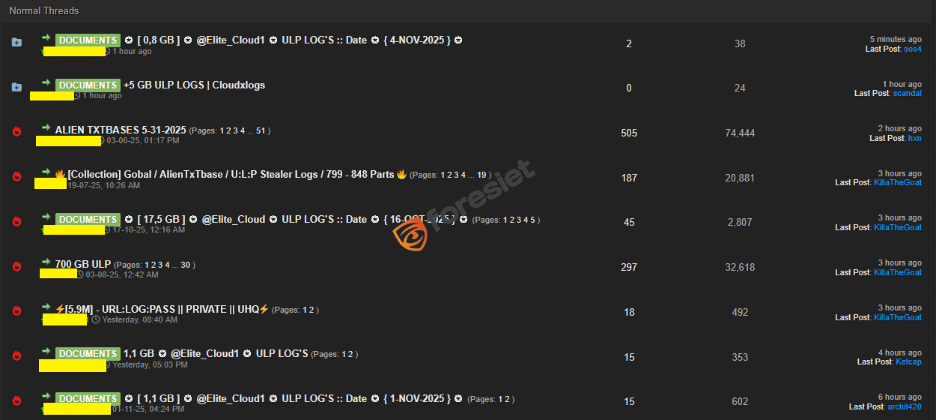
Screenshot from a dark-web market showing credential dumps being traded — illustrating how stolen credentials now act as primary entry currency for attackers
1. The Big Threats Emergent in 2026
Generative AI & Credential Abuse
Generative AI isn’t just a buzzword. Cybercriminals are already using it to automate vulnerability scans, craft deep-fake impersonations and spin up phishing kits that mimic trusted internal users. These tools significantly amplify the effectiveness of stolen credentials — when attackers simply log in rather than “hack in”. This makes credential-based intrusions and digital footprint analysis vital for brand protection.
A growing number of underground communities are now sharing “AI jailbreak” prompts — methods used to bypass content or security restrictions in large-language models. These discussions highlight a new grey-market trend where adversaries repurpose generative AI systems for phishing, malware writing, and social-engineering tasks.

Underground forum post advertising “AI Jailbreak” prompts — showing how attackers experiment with AI model manipulation for malicious use

North Korean hackers caught using AI face-filters during fake job interviews — a vivid example of how deepfake and generative-AI tools are weaponized for social engineering and credential theft
Quantum Computing & Obsolete Encryption
Even as quantum computing remains nascent, the implications are massive. According to industry commentary, this technology threatens to render many existing encryption standards obsolete — meaning tomorrow’s secure data could become today’s easy target.
Ransomware-as-a-Service (RaaS)
Modern Ransomware-as-a-Service dashboard showing how threat actors now operate professionalized, AI-enhanced platforms similar to SaaS businesses.
Supply-Chain & Third-Party Exploits
Compromising a trusted vendor or third-party provider now provides attackers with a multiplier effect. Supply-chain risks remain among the highest priority threats: a single breach can cascade into hundreds of downstream victims.
2. Underlying Trends Fueling the Threat Landscape
- Lowered barrier to entry: With RaaS, phishing-kits, and AI automation available cheaply, the number of threat actors is exploding.
- Credentials become currency: Instead of breaking in, attackers increasingly buy or harvest valid accounts and tokens. Monitoring for compromised data and active sessions becomes key.
- Underground economy sophistication: Dark-web markets now act much like legitimate platforms — complete with subscription models for access, resale of credentials, and digital threat scoring hidden behind forums.
- Geopolitical convergence: Nation-state actors are now using commercially available tools, and criminal affiliates are adopting espionage techniques. The line between profit-driven and state-driven attacks blurs.
3. Which Industries Are Most Vulnerable?
While no sector is exempt, certain industries carry higher risk profiles:
- Government & public administration: Because national defence and public services are high-value targets.
- Critical infrastructure (energy, utilities, telecom): Disruption here carries public safety and national security implications.
- Finance & fintech (including DeFi): With massive flows of value and emerging unregulated systems, attack payoff is high.
- Retail & e-commerce: Especially where third-party payment systems or marketplaces are involved — the blast radius of one breach can affect many.
- Healthcare: With large stores of personal data + critical uptime requirements, healthcare remains a favourite for attackers.
4. Key Defense Strategies You Can Deploy Now
- Compromised Data Tracking & Dark-Web Surveillance: Invest in tools and services that monitor your brand’s presence on the dark web, credential resale listings, and invalid login attempts using stolen credentials.
- Digital Threat Scoring & Exposure Management: Move from “will we be attacked” to “when we are attacked” mindset. Map all your digital assets, third-party exposures, cloud tokens and rank them by threat-score.
- Brand Impersonation Defense: Adopt mechanisms to detect and shut down fake web sites, cloned social accounts or email domains that mimic your brand — a rising vector in credential harvesting.
- Zero-Trust and Continuous Verification: Assume no device or user is trusted by default; enforce strict access controls, monitor behavior and revoke access when anomalies appear.
- Vendor & Supply-Chain Risk Protocols: Create software-bill-of-materials (SBOM) for your systems, require third parties to share security posture, and continuously monitor third-party breaches.
Conclusion
The path into 2026 is already paved with threats that scale faster, cost more and exploit trust more ruthlessly than ever before. Organizations that ignore the signals — that fail to include dark-web monitoring, stolen credential detection, and exposure mapping in their strategy — will find themselves reacting rather than leading. As Foresiet’s intelligence suggests, understanding the evolving threat landscape isn’t optional—it’s essential. If you shift from fear to foresight and build your defence around visibility, threat intelligence and resilient architecture, you’ll move from being a target to becoming a challenger. That’s how you tip the odds in your favour.
About us!
Foresiet is the pioneering force in digital security solutions, offering the first integrated Digital Risk Protection SaaS platform. With 24x7x365 dark web monitoring and proactive threat intelligence, Foresiet safeguards against data breaches and intellectual property theft. Our robust suite includes brand protection, takedown services, and supply chain assessment, enhancing your organization’s defense mechanisms. Attack surface management is a key component of our approach, ensuring comprehensive protection across all vulnerable points. Compliance is assured through adherence to ISO27001, NIST, GDPR, PCI, SOX, HIPAA, SAMA, CITC, and Third Party regulations. Additionally, our advanced antiphishing shield provides unparalleled protection against malicious emails. Trust Foresiet to empower your organization to navigate the digital landscape securely and confidently.
Generative AI & Credential Abuse
Latest
From the blog
The latest industry news, interviews, technologies, and resources.