
Blog categories

Weekly newsletter
No spam. Just the latest releases and tips, interesting articles, and exclusive interviews in your inbox every week.
Latest from the blog
CVE-2025-61882: Oracle E-Business Suite Under Mass Exploitation by Cl0p Ransomware
Posted on: 10 October 2025 | Author: Foresiet
Introduction
A critical CVE-2025-61882 Oracle E-Business Suite vulnerability is under active exploitation by the Cl0p ransomware group. This unauthenticated remote-code-execution (RCE) vulnerability — CVE-2025-61882 — in Oracle E-Business Suite (EBS) was patched by Oracle in October 2025 and is being actively exploited in the wild. Multiple security vendors attribute attacks to Cl0p/associated ransomware extortion campaigns and Oracle has published an emergency Security Alert. If you run EBS (12.2.3 → 12.2.14) you must apply the emergency updates or apply network compensating controls immediately

Why this matters
EBS commonly hosts sensitive corporate functions — HR, finance, procurement — and a successful unauthenticated RCE gives attackers the ability to fully compromise application servers, move laterally, exfiltrate data, and deploy ransomware. Evidence indicates extortion-focused actors have weaponized the flaw and are using it against unpatched systems.
The technical root cause (high level, safe)
Oracle’s advisory and vendor analysis point to an unauthenticated path in the EBS Concurrent Processing component — specifically the BI Publisher / Concurrent Processing integration — that allows an attacker with HTTP network access to cause remote code execution on the EBS application tier. The flaw is exploitable over the network without authentication, which is what makes it critical (CVSS ≈ 9.8 reported). The common exploitation pattern observed in related incidents is:
- Attacker scans for internet-accessible EBS endpoints.
- Trigger the vulnerable HTTP path in BI Publisher / Concurrent Processing to get code execution in the context of the EBS application user.
- Drop persistence binaries or run post-exploitation tooling, then move laterally/exfiltrate and deploy ransomware
Below is a safe fingerprinting script (Python) that checks for an exposed Oracle E-Business Suite HTTP endpoint. It does not attempt exploitation — it only performs HTTP HEAD/GET checks and looks for EBS fingerprint strings in HTML headers/body. Use it to show readers how defenders or sysadmins can check coverage before patching. (Run from a management host, and only scan your own assets or assets you are authorized to test.)
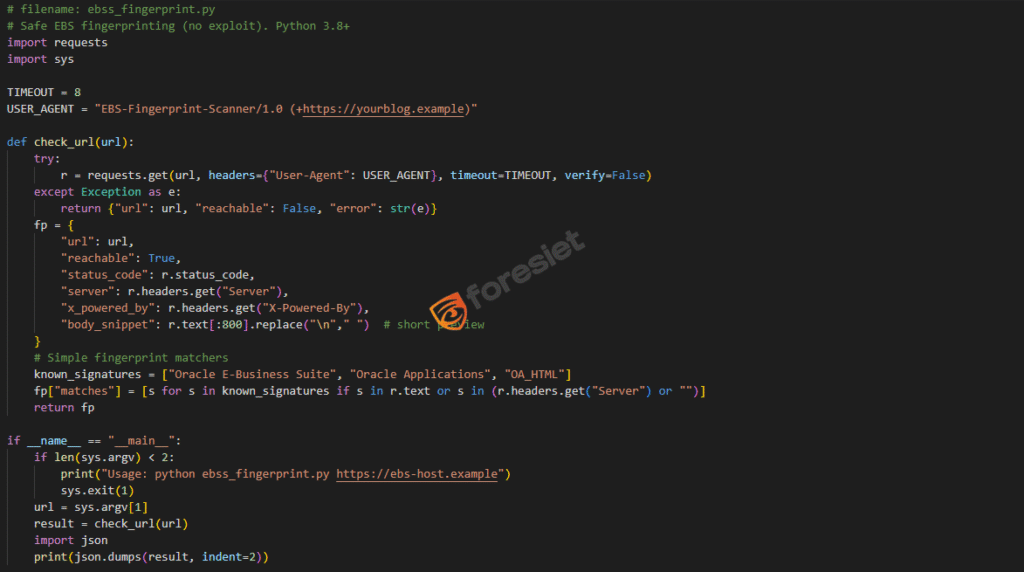
We include a small, safe script that checks whether an Oracle E-Business Suite site is reachable — it does not attempt to exploit anything. Run it from a machine you control (for example: python ebss_fingerprint.py https://ebs.example), then screenshot the JSON output and paste it here. This helps non-technical readers see what a presence check looks like without performing risky actions.
Detection & SOC playbook (copy/paste-ready)
1) Splunk (example) — detect suspicious POSTs against EBS endpoints

2) Sigma rule (conceptual)
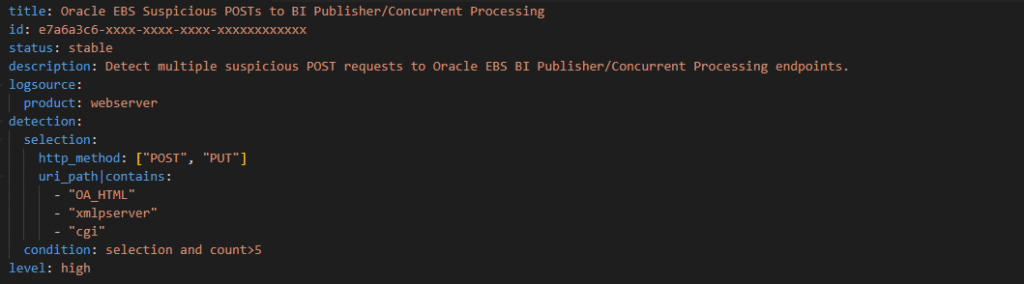
3) Suricata / Snort (network) — Detect likely exploit attempts (network signature)

Rationale: Generic detection for web traffic targeting known EBS endpoints. Tune HOME_NET and add rate thresholds.
4) Host hunt (Windows / Linux)
- Look for unexpected child processes of the EBS app user (e.g., java spawning bash, exe, ps, or perl with unusual command line args).
- Look for new binaries under webapp directories and unusual outbound connections shortly after suspicious HTTP traffic.
The July 2025 CPU (context)
Oracle’s July 2025 CPU for EBS contained 9 fixes across EBS components; three of those were flagged as possibly exploitable over the network without authentication. The July CPU should be considered a prerequisite for subsequent updates in some patch chains — verify Oracle’s install prerequisites before applying hotfixes. Example CVEs from July 2025 CPU include: CVE-2025-30743, CVE-2025-30744, CVE-2025-50105, CVE-2025-50071, CVE-2025-30746, CVE-2025-30745, CVE-2025-50107, CVE-2025-30739, CVE-2025-50090. If your estate is EBS-affected, apply July CPU and then Oracle’s emergency updates as recommended.
Closing (Call to Action)
If you manage EBS environments: schedule emergency maintenance, apply Oracle’s updates, and use the fingerprinting & detection snippets above to hunt for signs of abuse. If you want, I can:
- Build a one-page printable incident alert PDF (with IOCs embedded) — ready to circulate to execs; or
- Generate a CSV/Excel of vendor IOCs (Rapid7 / CrowdStrike / Oracle) for SIEM ingestion; or
- Produce tuned Sigma & Splunk rules adapted for your SIEM and environment.
Conclusion
The exploitation of CVE-2025-61882 underscores how rapidly threat actors weaponize newly disclosed vulnerabilities, especially in enterprise-critical platforms like Oracle E-Business Suite.
The Cl0p group’s activity around this CVE demonstrates a continuing trend: financially motivated ransomware operators quickly pivot to high-impact business applications that expose sensitive corporate data.
Organizations running EBS must act with urgency — apply Oracle’s emergency patch or restrict external access immediately, then validate through proper detection and monitoring.
Security teams should use the fingerprinting, Splunk, Sigma, and Suricata snippets in this blog to hunt for compromise indicators and verify network hygiene.
The lesson is clear: timely patch management and layered detection remain the most effective defenses against modern exploitation campaigns.
Stay proactive, monitor Oracle advisories closely, and treat every internet-facing business system as a potential attack surface.
About us!
Foresiet is the pioneering force in digital security solutions, offering the first integrated Digital Risk Protection SaaS platform. With 24x7x365 dark web monitoring and proactive threat intelligence, Foresiet safeguards against data breaches and intellectual property theft. Our robust suite includes brand protection, takedown services, and supply chain assessment, enhancing your organization’s defense mechanisms. Attack surface management is a key component of our approach, ensuring comprehensive protection across all vulnerable points. Compliance is assured through adherence to ISO27001, NIST, GDPR, PCI, SOX, HIPAA, SAMA, CITC, and Third Party regulations. Additionally, our advanced antiphishing shield provides unparalleled protection against malicious emails. Trust Foresiet to empower your organization to navigate the digital landscape securely and confidently.
Latest
From the blog
The latest industry news, interviews, technologies, and resources.
One Response