
Blog categories

Weekly newsletter
No spam. Just the latest releases and tips, interesting articles, and exclusive interviews in your inbox every week.
Latest from the blog
CVE-2026-20127: In-Depth Analysis of the Cisco Catalyst SD-WAN Authentication Bypass Vulnerability
Posted on: 27 Feb 2026 | Author: Foresiet
Software-defined networking (SD-WAN) has transformed enterprise infrastructure, enabling dynamic connectivity between sites with centralized management and control. But when the control plane itself becomes vulnerable, network integrity is no longer a given. CVE-2026-20127 is exactly that kind of vulnerability — a critical authentication bypass affecting SD-WAN management components that has been exploited in real environments for years and can deliver full administrative access to attackers without valid credentials.
This blog examines the flaw, how it works, how threat actors have used it, relevant indicators of compromise, and the technical characteristics that defenders should know to detect and remediate this risk effectively.
The Core of the Flaw
At its heart, the issue is straightforward but severe: the peering authentication mechanism in SD-WAN controllers and managers does not correctly validate peer credentials before allowing an entity to join the control plane. An attacker who can reach this interface can craft specific requests that bypass authentication entirely and gain access to a privileged account that should have been protected.
Once inside as a privileged user, the attacker can interact with NETCONF — the protocol used to configure network elements — to push policies, alter routing behavior, and modify the SD-WAN fabric itself. This isn’t merely a local account compromise; it’s control of how an organization’s network functions at a fundamental level.
How Exploitation Happens
The vulnerability exists because the authentication logic for control plane peering does not enforce proper checks. Instead of requiring valid peer credentials and cryptographic validation, the code path in the controller allows certain crafted messages to succeed without rejecting unauthorized attempts.
Exploitation is entirely remote and unauthenticated. A single request sequence to the exposed control interface can grant access as an internal, high-privileged, non-root account.
Our Cybersecurity Risk Assessment indicates that the threat actor UAT-8616 has been leveraging this flaw since at least 2023. The attack chain is sophisticated:
Initial Access: Using the auth bypass to enter the management plane.
Root Escalation: Exploiting that secondary path traversal flaw to gain total control of the SD-WAN fabric.
Here’s a simplified representation of how an exploit sequence might work, in pseudo-code form:
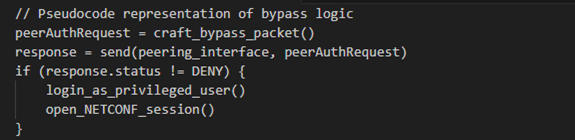
The key weakness is that the authentication logic never checks for a properly signed or validated peer handshake, effectively defaulting to “allow” when it should stop unauthenticated requests. This logic flaw can be triggered with a few crafted packets, and because it occurs before any deeper checks, no credentials are required at any point.
Once authenticated, the attacker’s session looks legitimate to the system’s internal monitoring, since it appears to come from a high-privilege internal account. This makes detection based on behavior alone significantly harder.
Exploitation in the Wild and Operational Impact
Evidence compiled from monitoring and incident response engagements indicates that this vulnerability has been exploited since at least 2023 in real environments. Threat actors have used it to introduce rogue peers into SD-WAN control planes, enabling persistent administrative access.
Once a rogue peer is added, attackers are able to:
- Manipulate SD-WAN routing and configuration templates
- Push unauthorized policies across multiple network endpoints
- Modify VPN or tunnel settings to intercept or redirect traffic
- Introduce backdoors into network management workflows
In documented cases, attackers went further: after gaining internal access, they conducted a controlled downgrade of software versions to make additional privilege-escalation vulnerabilities exploitable, further enhancing their foothold and eventually achieving root-level control.
This demonstrates a classic multi-stage exploitation pattern where an initial flaw becomes the springboard for deeper compromise. Because this control plane governs connectivity across sites, the operational impact of such a breach is far larger than a typical endpoint compromise.
Indicators of Compromise (IOCs)
Real attacker activity leaves traces, and defenders should know what to look for. Important signs include:
- Unexpected control plane peering events appearing in SD-WAN logs
- New peer additions that do not match documented system topologies
- Authentication log entries indicating high-privilege logins without valid credentials
- Sudden configuration changes on multiple devices that do not correspond to scheduled maintenance
- Version downgrades followed by unusual NETCONF activity
Network logs should be queried for entries similar to:

Cross-referencing peer IPs against known system inventories and expected device roles can reveal anomalies. Logs that show unexpected control connections or inconsistent peer types (vsmart, vmange, vedge, vbond) are often early indicators that compromise has occurred.
Technical Background: NETCONF and SD-WAN
NETCONF (Network Configuration Protocol) is used by SD-WAN systems to manage configuration data between controllers and managed devices. It runs over secure channels and typically requires strong authentication to prevent unauthorized access.
The flaw in question effectively sidesteps this authentication layer. Once an attacker has a session as a privileged non-root user, NETCONF commands can be issued to adjust templates, modify cryptographic keys, alter routing tables, or propagate configuration changes across the fabric.
Because this interface directly impacts network behavior, there’s no need for additional exploits post-access to gain meaningful control — the initial bypass itself confers operational power disproportionate to the privilege level.
Incident Response and Remediation
In response to CVE-2026-20127, patched releases have been published that enforce proper peering authentication logic and eliminate the bypass condition across major SD-WAN versions. These patches replace the vulnerable authentication handshake and prevent unauthorized session establishment.
For environments facing active threat exposure, immediate steps include:
- Applying firmware versions that address the vulnerability
- Restricting exposure of the control plane interfaces to internal networks only
- Reviewing logs for historical signs of compromise
- Auditing recent configuration and peer addition events
Remediation MUST include patching, as no reliable workaround exists that fully mitigates the logic flaw without addressing the underlying authentication code path.
Conclusion
CVE-2026-20127 is a vivid example of how a flaw in a central control mechanism can compromise entire enterprise networks. A simple authentication bypass in the peering mechanism allowed attackers to forge privileged sessions, gain administrative control over SD-WAN systems, and manipulate network behavior without detection for extended periods.
For defenders, the lessons are clear: even core networking control software must be treated with the same scrutiny as application firewalls and servers. SD-WAN devices that combine management, peering, and configuration services must enforce strict authentication to ensure the operational integrity of the network.
Organizations relying on SD-WAN architectures should treat this incident as a reminder that threats targeting control planes are real, that indicators often hide in plain sight in logs, and that prompt remediation is essential when weaponizable vulnerabilities are present.
About us!
Foresiet is the pioneering force in digital security solutions, offering the first integrated Digital Risk Protection SaaS platform. With 24x7x365 dark web monitoring and proactive threat intelligence, Foresiet safeguards against data breaches and intellectual property theft. Our robust suite includes brand protection, takedown services, and supply chain assessment, enhancing your organization’s defense mechanisms. Attack surface management is a key component of our approach, ensuring comprehensive protection across all vulnerable points. Compliance is assured through adherence to ISO27001, NIST, GDPR, PCI, SOX, HIPAA, SAMA, CITC, and Third Party regulations. Additionally, our advanced antiphishing shield provides unparalleled protection against malicious emails. Trust Foresiet to empower your organization to navigate the digital landscape securely and confidently.
Latest
From the blog
The latest industry news, interviews, technologies, and resources.