
Blog categories

Weekly newsletter
No spam. Just the latest releases and tips, interesting articles, and exclusive interviews in your inbox every week.
Latest from the blog
CVE-2026-21643: Pre-Authentication SQL Injection in Endpoint Management Server Leading to Remote Code Execution
Posted on: 15 April 2026 | Author: Foresiet
Introduction
CVE-2026-21643 is a critical SQL injection vulnerability in the administrative web interface of FortiClient Endpoint Management Server version 7.4.4. It allows unauthenticated remote attackers to execute arbitrary SQL commands through specially crafted HTTP requests, primarily by injecting malicious payloads via the Site HTTP header. This flaw, introduced during refactoring for multi-tenant support, bypasses authentication entirely on affected endpoints and can lead to full system compromise, including command execution on the underlying PostgreSQL database and host. Active exploitation has been confirmed in the wild since early 2026, often targeting exposed management servers for initial access and lateral movement.
Executive Summary
Rated CVSS 9.1, this pre-authentication flaw stems from improper sanitization of tenant identification headers passed directly into database queries before any login checks. Exploitation requires only network access to the HTTPS interface and a single crafted request to endpoints like /api/v1/init_consts or /api/v1/auth/signin. Successful attacks enable arbitrary SQL execution, data exfiltration, privilege escalation, and remote code execution via PostgreSQL features such as COPY FROM PROGRAM. Patched in 7.4.5 and unaffected branches (7.2.x, 8.0.x), it joins a pattern of endpoint management risks when combined with historical flaws like use-after-free in document viewers, out-of-bounds reads in logging drivers, deserialization issues in mail servers, improper link resolution in task hosts, and insecure library loading in scripting environments. Immediate patching and exposure reduction are required.
Patching to version 7.4.5 is your first line of defense, but the risk doesn’t end there. If your server was unpatched, your administrative credentials might already be at risk. Beyond just updating, utilizing proactive Dark Web Monitoring Tools can provide real-time alerts if your organization’s data appears on illicit forums, helping you move from a reactive to a proactive defense posture.
Technical Analysis: How the Vulnerability Works
The root cause lies in the middleware and database connection layer for multi-tenant mode. The Site header value is concatenated unsanitized into SQL queries early in request processing. An attacker sends a GET or POST request with a payload such as:

This triggers time-based confirmation or more destructive commands. On PostgreSQL backends common to Linux EMS deployments, attackers escalate using:

This achieves OS command execution. The injection affects pre-auth paths, with no rate limiting on /api/v1/init_consts, enabling blind or stacked queries for database dumping, user creation, or persistence.
Example detection log entry from successful injection:

Forensic artifacts include anomalous PostgreSQL query logs with single quotes or semicolons, unexpected file creations in /tmp, and outbound connections from the EMS process.
Related vulnerabilities amplify exposure in mixed environments. CVE-2020-9715 enables use-after-free in Adobe Acrobat Reader via crafted PDFs, allowing code execution when users open malicious documents. CVE-2023-36424 is an out-of-bounds read in the Windows Common Log File System Driver, facilitating local privilege escalation. CVE-2023-21529 permits deserialization of untrusted data in Exchange Server for authenticated RCE via malicious PowerShell objects in SOAP messages. CVE-2025-60710 involves improper link resolution in the Host Process for Windows Tasks, enabling local privilege escalation through symlink manipulation. CVE-2012-1854 is an insecure library loading flaw in VBA, where a malicious DLL in the working directory of a .docx file executes on open.
Exploitation Patterns Observed
Threat actors target internet-exposed EMS instances, using the Site header for initial probing followed by data exfiltration or shell deployment. Campaigns chain this with endpoint compromises via document-based vectors or local escalations on Windows hosts. No mass scanning dominates; operations remain targeted against enterprises with centralized client management. Logs show repeated /api/v1/init_consts requests with varying injection strings, succeeded by PostgreSQL anomalies or unexpected child processes.
Indicators of Compromise (IOCs)
Monitor for:
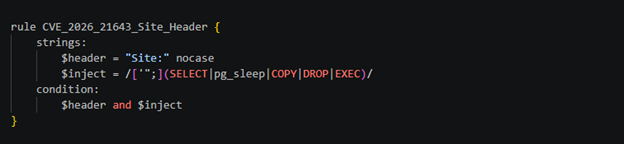
- HTTP requests to /api/v1/init_consts or /api/v1/auth/signin with Site header containing quotes, semicolons, or pg_sleep/COPY commands.
- PostgreSQL logs with syntax errors or stacked queries.
- Outbound connections or new files in /tmp from postgres/system users.
- Anomalous database users or modified tables.
Sample YARA-like pattern for network detection:
Mitigation and Best Practices
Upgrade immediately to FortiClient EMS 7.4.5 or later. Restrict administrative interface access to trusted IPs via firewalls or access controls. Enable WAF rules for SQL keywords in headers. Audit PostgreSQL and web logs for injection patterns. For related risks, maintain current patches on document readers, Windows components, mail servers, and scripting tools while avoiding untrusted files.
Want to stay ahead of emerging risks? You can find more CVE details and our full 2026 Threat Reports here to keep your team informed.
Conclusion
CVE-2026-21643 highlights persistent dangers in pre-authentication paths within management platforms, where a single header flaw grants database and system control. When viewed alongside complementary vulnerabilities in document handling, drivers, mail systems, task processes, and scripting, it reinforces the need for layered patching, strict network segmentation, and continuous log monitoring to protect endpoint ecosystems against evolving threats.
About us!
Foresiet is the pioneering force in digital security solutions, offering the first integrated Digital Risk Protection SaaS platform. With 24x7x365 dark web monitoring and proactive threat intelligence, Foresiet safeguards against data breaches and intellectual property theft. Our robust suite includes brand protection, takedown services, and supply chain assessment, enhancing your organization’s defense mechanisms. Attack surface management is a key component of our approach, ensuring comprehensive protection across all vulnerable points. Compliance is assured through adherence to ISO27001, NIST, GDPR, PCI, SOX, HIPAA, SAMA, CITC, and Third Party regulations. Additionally, our advanced antiphishing shield provides unparalleled protection against malicious emails. Trust Foresiet to empower your organization to navigate the digital landscape securely and confidently.
Latest
From the blog
The latest industry news, interviews, technologies, and resources.