
Blog categories

Weekly newsletter
No spam. Just the latest releases and tips, interesting articles, and exclusive interviews in your inbox every week.
Latest from the blog
FortiWeb CVE-2025-58034: Exploited Zero-Day Command Injection in WAF
Posted on: 20 Nov 2025 | Author: Foresiet
Introduction
In November 2025, threat intelligence teams began warning of a newly discovered zero-day vulnerability in a widely-deployed web application firewall appliance. The vulnerability — CVE-2025-58034 — allows authenticated attackers to execute arbitrary OS commands via crafted HTTP requests or CLI commands.
Because the vulnerable product is often deployed at the perimeter and trusted by defenders, the exploit path here is particularly dangerous: once an adversary lands valid credentials (or leverages another weakness) they may pivot through the firewall itself, compromising internal segments and exfiltrating data.
This blog unpacks the vulnerability, the exploitation context, affected versions, attack vectors, detection opportunities, mitigation steps, and strategic Threat Intelligence implications for defenders monitoring dark web chatter and adversary forums.
Vulnerability Overview
What is CVE-2025-58034
· The vulnerability is classified as Improper Neutralization of Special Elements used in an OS Command (“OS Command Injection”) (CWE-78).
· It affects the Fortinet FortiWeb product line:
o FortiWeb 8.0.0 through 8.0.1
o FortiWeb 7.6.0 through 7.6.5
o FortiWeb 7.4.0 through 7.4.10
o FortiWeb 7.2.0 through 7.2.11
o FortiWeb 7.0.0 through 7.0.11
· The vendor confirms that this vulnerability is actively exploited in the wild.
· Severity: High. According to sources: CVSS v3.1 base 7.2.
· EPSS score is ~0.04573 — indicating that exploit code or active cases are already tracked.
Why is this critical?
Because the firewall appliance often sits at the front line of the network, any compromise of that device means an adversary may gain deep internal visibility, traffic redirection, credential harvesting, lateral movement, or persistent foothold. The fact that OS command injection is possible means that the attacker may execute arbitrary code, download further payloads or disable telemetry and logging.
Attack Vector & Exploitation Scenario
How an adversary could exploit this
- Initial access / credential compromise: The attacker obtains valid administrative or privileged credentials for the FortiWeb interface (via phishing, credential reuse, compromised accounts, or other means).
- Command injection via HTTP or CLI: Using the vulnerability, the attacker crafts specially-formed HTTP requests (or directly uses the CLI) to inject OS commands.
- Post-exploitation activities: On successful code execution, the attacker can:
- Create new admin-level accounts
- Modify configuration (e.g., allow rule modifications, log disabling)
- Pivot into internal networks, exfiltrate traffic, deploy additional malware
- Persistence and lateral movement: Because the firewall device often holds sensitive data or sits in a privileged network segment, the attacker may abuse it as a jump-host to compromise other critical assets.
MITRE ATT&CK mapping
Phase | Technique | ID |
Initial Access | Valid Accounts | T1078 |
Execution | OS Command Injection | T1207 (or under T1059 variant) |
Lateral Movement | Exploit Public-Facing Application | T1190 |
Persistence | Create or Modify System Process | T1543 |
Privilege Escalation | Exploitation for Privilege Escalation | T1068 |
Defense Evasion | Disable or Alter System Logging | T1562 |
Typical indicators of exploit
- Unexpected CLI commands executed on a FortiWeb appliance
- New or altered admin-level accounts on the device
- Unusual outbound connections from the firewall appliance (e.g., to attacker C2)
- HTTP POST requests with suspicious payloads targeting the WAF API endpoint
Affected Versions & Vendor Response
- FortiWeb 7.0.0 → 7.0.11
- FortiWeb 7.2.0 → 7.2.11
- FortiWeb 7.4.0 → 7.4.10
- FortiWeb 7.6.0 → 7.6.5
- FortiWeb 8.0.0 → 8.0.1
- The vendor has released patches for affected versions. Administrators are strongly encouraged to apply updates immediately.
- This vulnerability has been added to the Cybersecurity and Infrastructure Security Agency (CISA) Known Exploited Vulnerabilities (KEV) catalog, forcing faster-than-normal patch expectations for U.S. federal civilian agencies.
Affected Versions & Vendor Response
- FortiWeb 7.0.0 → 7.0.11
- FortiWeb 7.2.0 → 7.2.11
- FortiWeb 7.4.0 → 7.4.10
- FortiWeb 7.6.0 → 7.6.5
- FortiWeb 8.0.0 → 8.0.1
- The vendor has released patches for affected versions. Administrators are strongly encouraged to apply updates immediately.
- This vulnerability has been added to the Cybersecurity and Infrastructure Security Agency (CISA) Known Exploited Vulnerabilities (KEV) catalog, forcing faster-than-normal patch expectations for U.S. federal civilian agencies.
Threat Intelligence Implications
Adversary opportunities
Because this is an active exploit, monitoring dark-web forums, private leak sites and adversary chatter for “FortiWeb exploit”, “CVE-2025-58034”, “Fortinet WAF zero-day” or “FWB CLI injection” keywords can be valuable.
What this means for SOC and threat teams
- Given that exploit requires valid credentials, detection systems should emphasise credential compromise detection and unusual admin access patterns.
- The compromised device may serve as a pivot for ransomware actors, so setting up lateral-movement detection on firewall appliances is critical.
- Because OS command execution is possible, monitoring endpoints of the appliance for new processes, C2 connections or unauthorized file changes is essential.
- Shadow IT deployments of FortiWeb may be outside patch-management schedules—asset inventory accuracy is key.
Strategic risk for enterprise infrastructure
- Firewalls/WAFs are high-value targets: compromise equals significant risk.
- Attackers can abuse this to bypass defence-in-depth: if the appliance is compromised, internal traffic and logs may be manipulated.
- The rapid addition to KEV list means compliance/regulation pressure will rise: organisations failing to patch may face regulatory or contractual consequences.
Detection & Hunting Guidance
Log & telemetry sources to monitor
- Management interface logs of FortiWeb (login attempts, account creation events)
- CLI command execution logs on FortiWeb appliance
- Unexpected outbound connections from the appliance (e.g., unusual IPs, domains)
- Changes in firewall/WAF policy or logging settings (especially disabled logging)
- Endpoint monitoring on the appliance for spawned unusual processes
Sigma rule Example (for FortiWeb login abuse)
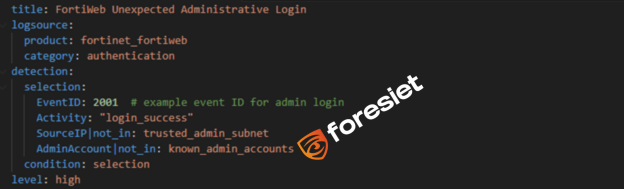
Example YARA-style pseudo rule (for detection of malicious CLI command payloads)

Mitigation & Recommended Actions
- Immediately verify whether you have any of the affected FortiWeb versions deployed.
- Apply the vendor patch as per Fortinet advisory.
- Restrict administrative access to the FortiWeb interface: only allow trusted IPs, use MFA, avoid exposing management interface to the public Internet.
- Monitor and audit all administrative account creation, CLI commands, changes in policy, outbound connections from the appliance.
- Consider compensating controls: if immediate patching not possible, disable or restrict vulnerable services, segregate the appliance, increase logging and alerting.
- Asset inventory check: Identify any unmanaged FortiWeb or WAF appliances in the environment.
- Incident response preparation: Develop playbooks for rapid isolation if appliance compromise is detected, including network segmentation, credential resets, and forensic image capture.
Timeline & Context
- November 18, 2025: Fortinet PSIRT advisory published for CVE-2025-58034. Immediately following, the vulnerability added to CISA KEV catalog.
- Threat research Blog analyses confirm active exploitations in the wild (SecPod, etc.).
Key Indicators of Compromise (IOCs)
- Unusual CLI commands on FortiWeb appliances (especially those invoking shell utilities)
- New administrative accounts created on FortiWeb
- Suspicious HTTP POST requests toward FortiWeb API endpoints with payloads symbolising command injection
- Outbound connections from FortiWeb appliance to previously unseen external IPs
- Version numbers on FortiWeb appliances still within ranges known to be vulnerable
Conclusion
CVE-2025-58034 is not just another vulnerability—its strategic placement in a perimeter-security device elevates it to high priority for threat hunters and defenders. Because the exploit is active and requires valid credentials, organisations must adopt both rapid patching and proactive detection strategies.
For threat intelligence practitioners, monitoring for the exploit toolkits, shared payloads, and chatter around “FortiWeb zero-day” can yield early warning of adversary campaigns. For SOCs and IR teams, the focus should be on what happens after a perimeter appliance is compromised—since the internal impact may be far greater than the external breach.Don’t wait for your WAF to become the attacker’s pivot.
About us!
Foresiet is the pioneering force in digital security solutions, offering the first integrated Digital Risk Protection SaaS platform. With 24x7x365 dark web monitoring and proactive threat intelligence, Foresiet safeguards against data breaches and intellectual property theft. Our robust suite includes brand protection, takedown services, and supply chain assessment, enhancing your organization’s defense mechanisms. Attack surface management is a key component of our approach, ensuring comprehensive protection across all vulnerable points. Compliance is assured through adherence to ISO27001, NIST, GDPR, PCI, SOX, HIPAA, SAMA, CITC, and Third Party regulations. Additionally, our advanced antiphishing shield provides unparalleled protection against malicious emails. Trust Foresiet to empower your organization to navigate the digital landscape securely and confidently.
Latest
From the blog
The latest industry news, interviews, technologies, and resources.