
Blog categories

Weekly newsletter
No spam. Just the latest releases and tips, interesting articles, and exclusive interviews in your inbox every week.
Latest from the blog
Leaked Credentials: The Hidden Supply Chain Powering Modern Ransomware Attacks
Posted on: 25 Feb 2026 | Author: Foresiet
Introduction: Ransomware Rarely Starts with Malware Anymore
Ransomware incidents are often perceived as sudden, destructive events triggered by malicious payloads. In reality, many modern ransomware attacks begin much earlier and in a far less visible way: with compromised credentials and pre-existing access sold in underground markets.
Threat intelligence collected from access broker activity and credential exposure sources indicates that ransomware operators increasingly rely on purchased access rather than direct exploitation. This shift reflects the maturation of an “access economy” that commoditizes entry into corporate networks and reduces the technical barriers to launching large-scale intrusions.
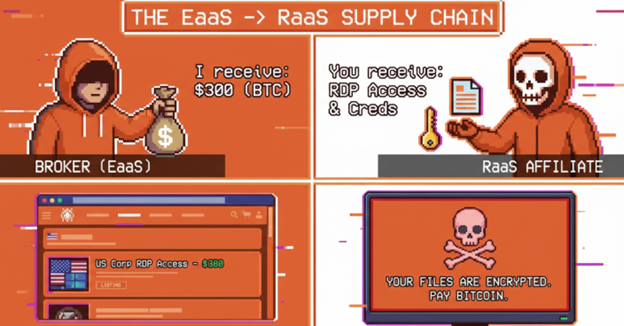
Many ransomware attacks begin with stolen credentials found on underground marketplaces. Organizations that use a Dark Web Monitoring tool in India can detect exposed accounts early and prevent attackers from gaining initial access.
The Access Economy: How Access-as-a-Service Fuels Ransomware
The underground economy has evolved beyond malware development into specialized service models. Access-as-a-Service (AaaS) and Exploit-as-a-Service (EaaS) providers supply ransomware affiliates with ready-made footholds into enterprise environments.
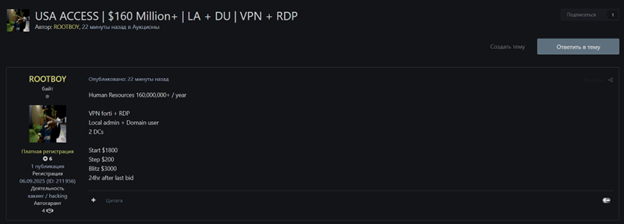
Underground listing advertising enterprise VPN and RDP access, illustrating the commoditization of initial access
Access-as-a-Service markets openly advertise footholds into corporate environments, including VPN and RDP access paired with privileged user accounts. These listings often contain operational details that demonstrate the depth of compromise being offered to buyers.
Instead of breaching perimeter defenses themselves, operators can acquire VPN, RDP, or domain-level access that has already been validated. These access points are often derived from credential exposure, stealer malware infections, or misconfigured remote services.
This market dynamic enables ransomware groups to scale operations rapidly and target organizations opportunistically, based on available access rather than technical vulnerability alone.
Leaked Credentials as a Ransomware Catalyst
Leaked credentials continue to represent one of the most reliable enablers of enterprise compromise.
Specifically, credentials originating from historical breaches, infostealer malware, and reused password datasets are routinely aggregated and monetized within underground forums.
Once valid credentials are obtained, attackers can bypass many traditional perimeter controls by authenticating as legitimate users. Consequently, this allows threat actors to blend into normal network activity during the early stages of an intrusion. As a result, they can significantly reduce detection risks and increase their dwell time prior to a final ransomware deployment.
Furthermore, from an operational perspective, credential-based access simplifies intrusion workflows. Ultimately, this shifts the defensive challenge away from simple exploit detection and toward the more complex realm of identity and access security.
From Access Sale to Ransomware Deployment: The Intrusion Lifecycle
Access acquisition is only the starting point. Once access is obtained either through leaked credentials or brokered footholds threat actors typically proceed through a predictable intrusion lifecycle:
- Establishing persistence within the environment
- Escalating privileges to gain broader administrative control
- Moving laterally to identify high-value systems and data repositories
- Evading security controls to maintain operational stealth
- Deploying ransomware and executing data exfiltration
This progression highlights why ransomware is best understood as the final stage of a broader intrusion campaign rather than a standalone event.
Business Impact: Why Initial Access Risk Is an Enterprise Issue
The financial and operational consequences of ransomware attacks extend beyond ransom payments. Credential-driven intrusions expose organizations to:
- Prolonged operational downtime
- Loss of sensitive data
- Regulatory and compliance exposure
- Reputational damage and customer trust erosion
Because initial access may occur weeks or months before ransomware deployment, organizations often underestimate the scope of compromise until significant damage has already occurred.
Defensive Priorities: Reducing Exposure to Access-Based Intrusions
Reducing ransomware risk requires a strategic focus on preventing and detecting initial access rather than solely reacting to malware payloads. Effective defensive priorities include:
- Enforcing strong authentication and reducing credential reuse
- Expanding multi-factor authentication coverage across remote access services
- Monitoring for anomalous authentication patterns and access abuse
- Strengthening identity governance and privileged access management
- Improving visibility into credential exposure risks through threat intelligence
Shifting security investment toward identity and access security addresses the earliest and most consequential stages of the ransomware kill chain.
Conclusion
Modern ransomware operations are not solely a malware problem they are a supply chain problem driven by the commoditization of access. The rise of Access-as-a-Service markets and the persistent availability of leaked credentials have fundamentally altered how ransomware campaigns are launched and scaled.
Organizations that focus defensive strategies on the ransomware payload alone will continue to operate reactively. Addressing the access layer where intrusions truly begin offers a more durable path to reducing enterprise ransomware exposure.
About us!
Foresiet is the pioneering force in digital security solutions, offering the first integrated Digital Risk Protection SaaS platform. With 24x7x365 dark web monitoring and proactive threat intelligence, Foresiet safeguards against data breaches and intellectual property theft. Our robust suite includes brand protection, takedown services, and supply chain assessment, enhancing your organization’s defense mechanisms. Attack surface management is a key component of our approach, ensuring comprehensive protection across all vulnerable points. Compliance is assured through adherence to ISO27001, NIST, GDPR, PCI, SOX, HIPAA, SAMA, CITC, and Third Party regulations. Additionally, our advanced antiphishing shield provides unparalleled protection against malicious emails. Trust Foresiet to empower your organization to navigate the digital landscape securely and confidently.
Latest
From the blog
The latest industry news, interviews, technologies, and resources.