
Blog categories

Weekly newsletter
No spam. Just the latest releases and tips, interesting articles, and exclusive interviews in your inbox every week.
Latest from the blog
MongoBleed (CVE-2025-14847): How to Fix the Critical MongoDB Memory Leak
Posted on: 31 Dec 2024 | Author: Foresiet
Introduction
CVE-2025-14847, nicknamed MongoBleed, is a high-severity (CVSS 7.5–8.7) unauthenticated information disclosure vulnerability in MongoDB Server. It allows remote attackers to leak uninitialized heap memory containing sensitive data—such as credentials, API keys, session tokens, and PII—without authentication. Exploitation occurs pre-authentication via malformed zlib-compressed network packets on port 27017.
Discovered internally by MongoDB on December 12, 2025, patched December 19, and publicly disclosed shortly after, the flaw saw public PoC release on December 26 and in-the-wild exploitation within days. As of December 30, 2025, over 87,000 internet-exposed instances remain vulnerable (Censys/Shodan data), with 42% of cloud environments affected.
To stay ahead, security teams should cross-reference their logs with a Threat Intelligence Platform to identify known malicious IP addresses. By doing so, you can prioritize patching for internet-facing instances that are under active observation by threat actors.
Executive Summary
MongoBleed exposes a critical flaw within MongoDB’s zlib decompression logic. Specifically, this vulnerability enables attackers to extract sensitive server memory fragments by crafting specialized OP_COMPRESSED messages that contain mismatched lengths. While this is not a direct Remote Code Execution (RCE) vulnerability, the leaked secrets—such as API keys and session tokens—frequently facilitate dangerous follow-on attacks, including credential stuffing or lateral movement within a network.
Furthermore, the threat is no longer theoretical, as public exploits now exist and mass scanning is currently ongoing across the global internet. Consequently, immediate patching is absolutely essential for all self-hosted instances. In contrast, users of MongoDB Atlas can remain confident as those environments have already been auto-patched.
Vulnerability Details
- CVE ID — CVE-2025-14847
- Severity — High (CVSS 7.5 base; some sources 8.7)
- Affected Versions:
- 8.0.x < 8.0.5 (or 8.0.17 in some branches)
- 7.0.x < 7.0.15 (or 7.0.28)
- 6.0.x < 6.0.19 (or 6.0.27)
- 5.0.x < 5.0.29 (or 5.0.32)
- 4.4.x all < latest legacy patch
- Older series (4.2, 4.0, 3.6) fully vulnerable
- Fixed Versions → Upgrade to latest in each branch (e.g., 8.0.17+, 7.0.28+)
- Root Cause → In message_compressor_zlib.cpp, server returns allocated buffer size instead of actual decompressed length, leaking adjacent heap memory in error responses.
Technical Mechanism:
- Attacker sends OP_COMPRESSED + OP_MSG with fake uncompressed size.
- Server allocates large buffer, decompresses small payload.
- Bug causes return of uninitialized memory in response.
- Iterating offsets leaks reconstructible data.
Simplified PoC behavior:

This yields BSON fragments, credentials, etc.
Exposure Landscape
Internet-wide scans (December 2025) reveal massive exposure:
- ~87,000 publicly accessible instances observed during internet-wide scans.
- Top countries: US (~20K–48K), China (~17K), Germany (~8K), India/France.
- Primary port: 27017 dominant.
screenshot from FOFA (search: app=”MongoDB”) as of December 30, 2025, aligns perfectly:
- 1,310,744 total results (951,533 unique IPs).
- Top countries: US (458,162), GB (159,050), CN (107,988), DE (93,339), IN (52,693).
- Top open ports led by 27017.
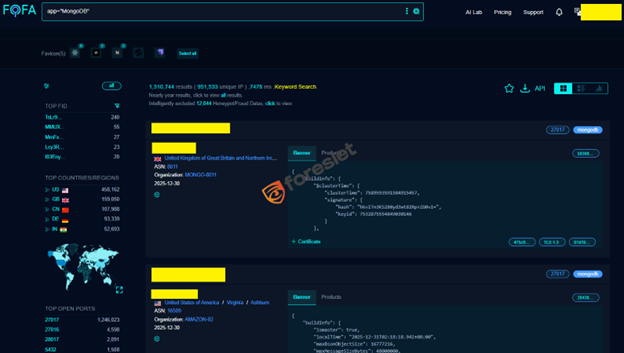
FOFA search results for app=”MongoDB” (December 30, 2025)—over 1.3M instances, heavy concentration in US/GB/CN, port 27017 dominant
This underscores widespread misconfiguration: MongoDB should never face the public internet without auth/firewalling.
Indicators of Compromise (IOCs)
- Anomalous short-lived connections (thousands/minute) lacking client metadata (event ID 51800 missing).
- Rapid pre-auth failures from single IPs.
- Log patterns: High connection (22943) + disconnect (22944) without metadata.
Block known exploit sources if observed; monitor for outbound credential use.
Mitigation and Best Practices
Primary:
- Upgrade immediately to patched versions.
- MongoDB Atlas → Already protected.
Workarounds (if patching delayed):
- Disable zlib compression (set networkMessageCompressors: “zstd,snappy” or “snappy” only).
- Firewall port 27017—allow only trusted IPs.
- Enable authentication (scraping disabled by default in newer versions).
Detection:
- Ship MongoDB logs to SIEM; alert on missing metadata connections.
- Use tools like mongobleed-detector.
Long-term:
- Never expose MongoDB directly.
- Bind to localhost + tunnel (SSH/VPN).
- Regular vulnerability scanning.
Conclusion
MongoBleed revives Heartbleed-era risks for NoSQL deployments, exposing decades-old compression flaws to modern threats. With 87K+ vulnerable instances and active exploitation as of December 30, 2025, organizations must prioritize upgrades and exposure reduction. Proper hardening authentication, network segmentation, timely patching—remains the best defense against such pre-auth vulnerabilities.
About us!
Foresiet is the pioneering force in digital security solutions, offering the first integrated Digital Risk Protection SaaS platform. With 24x7x365 dark web monitoring and proactive threat intelligence, Foresiet safeguards against data breaches and intellectual property theft. Our robust suite includes brand protection, takedown services, and supply chain assessment, enhancing your organization’s defense mechanisms. Attack surface management is a key component of our approach, ensuring comprehensive protection across all vulnerable points. Compliance is assured through adherence to ISO27001, NIST, GDPR, PCI, SOX, HIPAA, SAMA, CITC, and Third Party regulations. Additionally, our advanced antiphishing shield provides unparalleled protection against malicious emails. Trust Foresiet to empower your organization to navigate the digital landscape securely and confidently.
Latest
From the blog
The latest industry news, interviews, technologies, and resources.