
Blog categories

Weekly newsletter
No spam. Just the latest releases and tips, interesting articles, and exclusive interviews in your inbox every week.
Latest from the blog
New Stealthy C# RAT NoobsaibotRAT Targets Windows with Advanced Features
Posted on: 24 Dec 2024 | Author: Foresiet
Remote Access Trojans (RATs) continue to be one of the most actively traded malware categories across dark web forums. Their appeal lies in flexibility: a single framework can support espionage, credential theft, ransomware staging, or long-term persistence. Recently our team Identified a dark web actor advertised a tool called “noobsaiBOT”, claiming it to be a fully custom, stealth-focused RAT with source code included, priced at $20,000 and offered as a one-time exclusive sale.
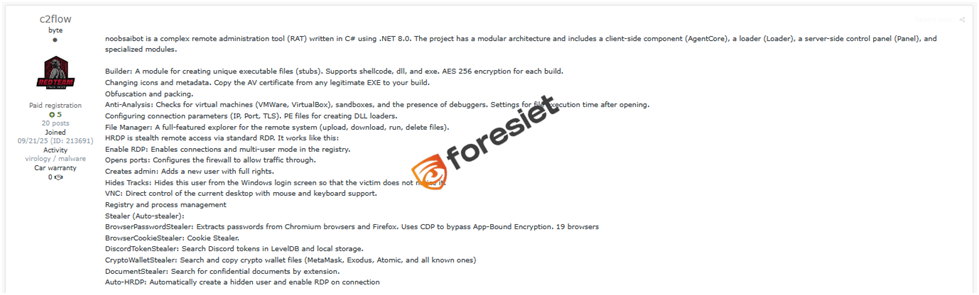
Screenshot shows the original dark-web forum sales post by the seller c2flow, outlining the claimed features and capabilities of the noobsaiBOT RAT.
Along with the sales pitch, the actor shared multiple builder and control-panel screenshots, presenting the malware as a mature, enterprise-grade offensive framework. This blog examines what is actually visible, what the screenshots reveal, how the claims compare to reality, and what defenders should take away from such offerings.
Overview of the noobsaiBOT Framework
According to the seller, noobsaiBOT is designed as a modular RAT ecosystem, consisting of:
- A client-side agent (malware payload)
- A loader component
- A server-side control panel
- Optional modules such as VNC, stealer components, and RDP-based access
From the screenshots alone, it is clear that the project follows a builder-based malware model, where attackers generate customized payloads through a graphical interface rather than manually compiling code.
The tool is positioned as an all-in-one solution, combining remote access, credential theft, file management, and persistence mechanisms under a single control panel.
Builder Interface: Masquerading and Payload Customization
One of the first screenshots reveals the builder module, where payloads are generated.
The interface allows the operator to modify executable metadata, including:
- File description (e.g., Windows Service)
- Company name (Microsoft Corporation)
- Copyright strings
- Version numbers matching legitimate Windows builds
This design clearly aims to impersonate legitimate Windows system binaries, increasing the chances of user trust and basic antivirus evasion.
The builder also exposes options for:
- Icon replacement
- Certificate cloning from legitimate executables (claimed)
- File size padding (“file pump”)
- TLS-enabled command-and-control communication
This is not a new technique. Metadata spoofing and certificate cloning are widely used across commodity RATs. The builder’s presence indicates a focus on ease of deployment, not necessarily technical novelty.
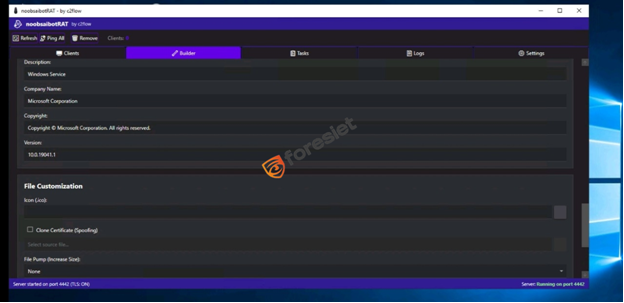
Screenshot shows the noobsaiBOT builder interface, highlighting executable metadata spoofing options such as fake Microsoft branding, versioning, icon replacement, and TLS-enabled C2 configuration.
Command-and-Control Configuration
The builder’s installation and persistence section reveals familiar yet effective tactics. Operators can deploy the malware as a standard EXE or through DLL sideloading, hijacking legitimate executables and common exports like version.dll. For staying power on infected machines, it leans on user-mode methods: dropping files into the startup folder, adding registry entries, creating scheduled tasks, or masquerading as benign services like WindowsUpdate.
These are classic persistence techniques borrowed from countless RATs over the years.
They work well on unprotected systems but stand little chance against properly tuned modern EDR solutions, which flag such registry modifications and scheduled tasks routinely.
One screenshot captures these options clearly, showing checkboxes for startup/registry persistence, advanced scheduled tasks, and service disguisehighlighting how straightforward it is for attackers to embed the malware deeply.Shifting to command-and-control setup, another panel displays connectivity configurations. Here, users set the server IP and port, enable TLS/SSL for encrypted communication, and fine-tune reconnect and startup delays. In the captured demo, the IP is localhost (127.0.0.1) on port 4444, a clear sign of controlled testing rather than real-world deployment.
TLS encryption is now table stakes for malware C2, protecting traffic from casual inspection. That said,NoobsaibotRAT shows no signs of more sophisticated evasion like domain fronting or abusing CDNs—keeping its infrastructure relatively basic and potentially easier to trace or block.
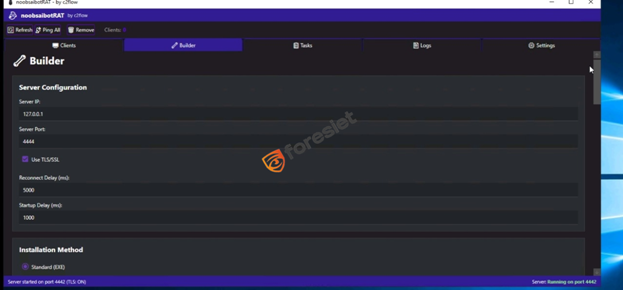
Screenshot shows the server configuration panel, including IP address, port, TLS/SSL encryption, and reconnect timing used for command-and-control communication.
Peering into the Victim: The Connected Clients Panel
The most telling screenshot comes from the Clients tab, where the operator monitors live connections. It lists detailed telemetry from the infected machine: computer name “GG,” logged-in as Administrator, tagged with a US country code, external IP 192.52.242.29, running Windows 10 (Win32NT build 17763), powered by an Intel Xeon E5 CPU with 6 GB RAM. Admin privileges are confirmed, alongside uptime (0.8 minutes) and a low 25ms ping.
This panel delivers classic RAT reconnaissance—quick host profiling and session oversight. Yet it reveals limitations: no signs of lateral movement tools, domain enumeration, or enterprise-grade features. NoobsaibotRAT stays firmly in the realm of single-system remote control rather than sophisticated network intrusion.
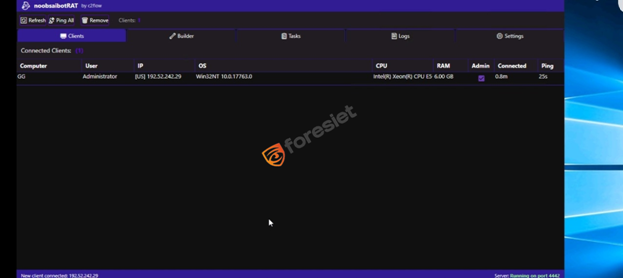
Screenshot displays the connected client panel, showing victim system details such as OS version (Win32NT), CPU type (Intel Xeon), available RAM (6 GB), IP address, and administrative access status.
Claimed Stealer and Remote Access Features
The seller boasts extensive data theft and control modules not visible in screenshots. These include stealers for browser passwords and cookies (covering 19 browsers via CDP bypass), Discord tokens, cryptocurrency wallets (MetaMask, Exodus, Atomic, etc.), and documents scanned by extension.
For remote access, it offers VNC for direct desktop manipulation with mouse/keyboard, plus HRDP—automated hidden RDP setup by enabling connections, opening ports, creating concealed admin users, and masking traces on the login screen.
Such stealer-RAT combinations are standard in today’s underground tools, showing solid but not groundbreaking engineering. Crucially, these claims lack screenshot evidence, remaining unverified promises.
Marketing Claims vs. Technical Reality
The listing repeatedly emphasizes:
- “Fully undetectable by Defender and EDR”
- “Runs on any Windows system, even without .NET”
- “Reflective in-memory execution”
- “Clean code, written from scratch”
However, screenshots alone do not validate:
- EDR bypass effectiveness
- Memory-only execution of all modules
- Long-term stealth in real environments
- Resistance against behavioral detection
These statements are marketing assertions, commonly used to justify high prices in underground marketplaces.
How to Protect Yourself
From a defensive perspective, tools like noobsaiBOT reinforce the importance of basic security hygiene:
- Enable behavior-based EDR, not signature-only AV
- Monitor DLL sideloading attempts
- Alert on suspicious scheduled tasks and registry persistence
- Restrict local administrator privileges
- Audit unexpected RDP enablement and hidden users
- Monitor outbound traffic for unknown TLS C2 endpoints
The techniques shown here are effective mainly against poorly monitored systems.
Conclusion
Despite its premium pricing and exclusivity claims, noobsaiBOT appears to be a well-packaged but largely conventional RAT framework. The screenshots confirm a polished builder, standard persistence methods, and basic victim telemetry — not a breakthrough in malware development.
Its real danger lies not in innovation, but in accessibility: lowering the barrier for attackers who want a ready-made remote access toolkit with modern branding.
For defenders, the takeaway is clear: most threats do not rely on zero-days or magic bypasses they rely on gaps in visibility and basic controls.
About us!
Foresiet is the pioneering force in digital security solutions, offering the first integrated Digital Risk Protection SaaS platform. With 24x7x365 dark web monitoring and proactive threat intelligence, Foresiet safeguards against data breaches and intellectual property theft. Our robust suite includes brand protection, takedown services, and supply chain assessment, enhancing your organization’s defense mechanisms. Attack surface management is a key component of our approach, ensuring comprehensive protection across all vulnerable points. Compliance is assured through adherence to ISO27001, NIST, GDPR, PCI, SOX, HIPAA, SAMA, CITC, and Third Party regulations. Additionally, our advanced antiphishing shield provides unparalleled protection against malicious emails. Trust Foresiet to empower your organization to navigate the digital landscape securely and confidently.
Latest
From the blog
The latest industry news, interviews, technologies, and resources.