
Blog categories

Weekly newsletter
No spam. Just the latest releases and tips, interesting articles, and exclusive interviews in your inbox every week.
Latest from the blog
Shiny Hunters’ Supply Chain Playbook: How Tech and Enterprise Get Breached Without Clicking a Single Phishing Link
Posted on: 18 May 2025 | Author: Foresiet
If you look at the cybersecurity setups of massive companies like Rockstar Games, Medtronic, or Amtrak, they look like digital fortresses. They spend millions on top-tier firewalls, hire elite security teams, and lock down their perimeters.
Yet, all of them have made headlines for major data breaches. Recent Data Breaches
How does this happen if their security is so good? The answer is simple: Attackers didn’t kick down the front door. They found a trusted vendor who already had a copy of the house key.
This strategy is known as a supply chain attack, and a notorious hacking collective called ShinyHunters has practically mastered it.
What Exactly is a Supply Chain Attack?
Think about how a modern business runs. A large company doesn’t build every single piece of software they use from scratch. They hire outside vendors for customer support chat boxes, use cloud platforms to store data, rely on third-party marketing tools, and use external software for payroll.
All of these outside vendors are plugged directly into the main company’s digital network.
A supply chain attack happens when hackers realize a giant target is too hard to breach directly. Instead of wasting time attacking the giant, they look at the dozen smaller vendor companies the giant works with. If one of those smaller vendors has weak security, the hackers break into them first. Once inside the vendor’s system, they ride the trusted connection straight into the main target’s network, completely bypassing the main perimeter defenses.
The Stealth Strategy of ShinyHunters
Unlike some hacking groups that break into a system and immediately lock everything down with ransomware to demand a quick payout, ShinyHunters plays the long game.
They specialize in quiet, stealthy operations. They break in, slip past detection by using legitimate vendor login credentials, and spend weeks silently downloading customer databases, source code, and internal communications. By the time anyone realizes they are there, the data is already being held for extortion or sold to the highest bidder on the dark web.
The breaches associated with Rockstar, Medtronic, and Amtrak proved a major point to the cybersecurity world: It doesn’t matter how strong your internal security is if you automatically trust outside connections.
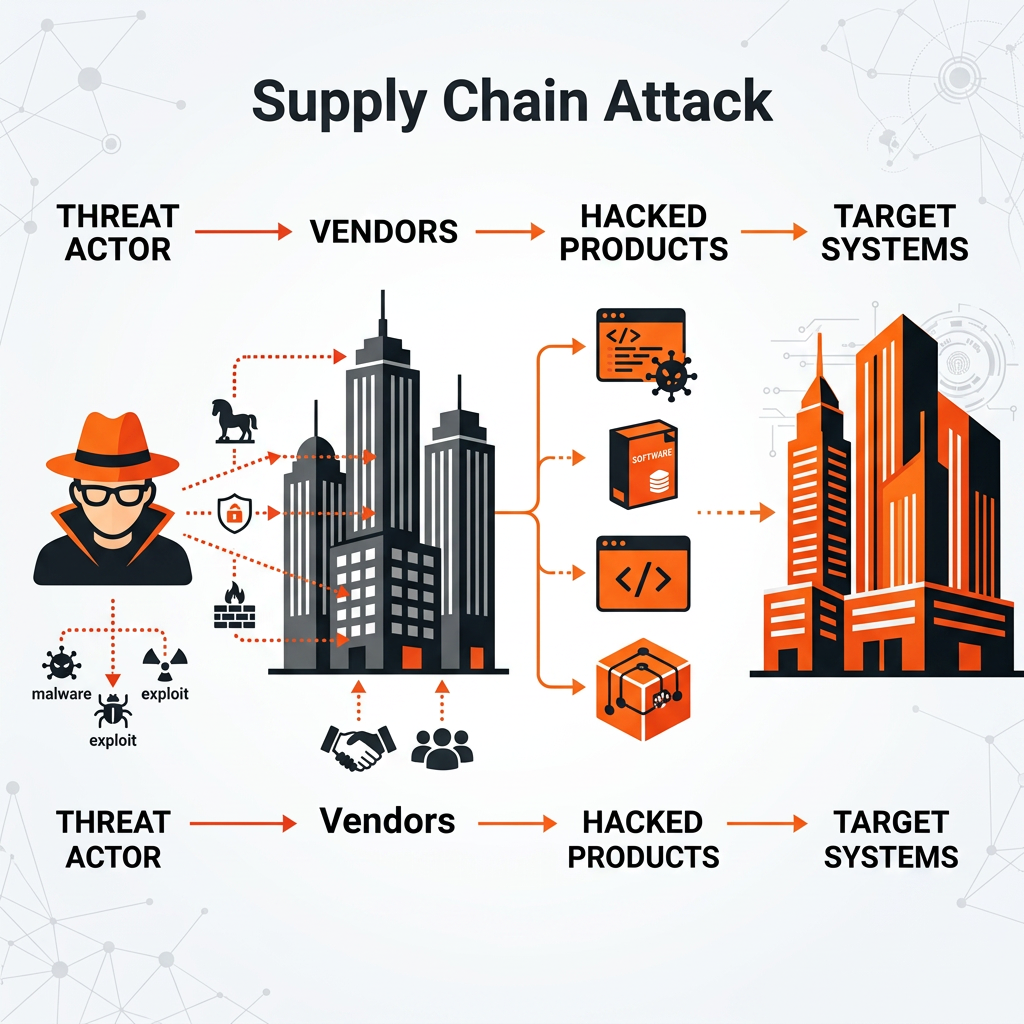
The Weakest Links They Look For
Hackers rarely use incredibly complex, movie-style code to break into these networks. Instead, they rely on basic human habits and configuration mistakes:
- Credential Theft: They target regular employees at vendor companies using basic phishing emails or password-stealing malware.
- Password Reuse: If a vendor’s employee uses the exact same password for their corporate account as they do for a random shopping website, hackers will eventually find it and use it to log right in.
- Over-Privileged Access: Companies often give their vendors way more access to their internal systems than the vendor actually needs to do their job. If the vendor gets compromised, the hacker gets total access.
How Companies Have to Adapt
The old way of doing cybersecurity—building a giant wall around your company and assuming everything inside the wall is safe—is officially dead. To survive modern threats, organizations are shifting to a Zero-Trust model.
In plain English, Zero-Trust means: Never trust, always verify.
It means treating every single login request—even if it comes from a vendor you’ve worked with for ten years—with the same level of suspicion. Companies have to enforce strict Multi-Factor Authentication (MFA), routinely audit the security of their partners, and closely monitor their networks for any weird behavior (like a vendor account suddenly downloading a massive database in the middle of the night).
Conclusion
Your digital security is only as strong as the weakest vendor you trust. As businesses become more connected, the companies that survive won’t just be the ones with the tallest walls—they’ll be the ones keeping a very close eye on who they let through the back door.
For a deeper look at these specific attack vectors and how to protect your organization, check out the full April 2026 Report for a complete breakdown.
About us!
Foresiet is the pioneering force in digital security solutions, offering the first integrated Digital Risk Protection SaaS platform. With 24x7x365 dark web monitoring and proactive threat intelligence, Foresiet safeguards against data breaches and intellectual property theft. Our robust suite includes brand protection, takedown services, and supply chain assessment, enhancing your organization’s defense mechanisms. Attack surface management is a key component of our approach, ensuring comprehensive protection across all vulnerable points. Compliance is assured through adherence to ISO27001, NIST, GDPR, PCI, SOX, HIPAA, SAMA, CITC, and Third Party regulations. Additionally, our advanced antiphishing shield provides unparalleled protection against malicious emails. Trust Foresiet to empower your organization to navigate the digital landscape securely and confidently.
Latest
From the blog
The latest industry news, interviews, technologies, and resources.