
Blog categories

Weekly newsletter
No spam. Just the latest releases and tips, interesting articles, and exclusive interviews in your inbox every week.
Latest from the blog
TP-Link CVE-2026-3227: Authenticated Command Injection via Configuration Import
Posted on: 27 Jun 2026 | Author: Foresiet
Prepared for: Corporate cybersecurity blog publication
Last verified: 2026-06-27
Scope: Defensive analysis only; no exploit payloads, shell commands, or operational PoC steps are included.
Primary sources: TP-Link advisory, CVE.org, NVD, FIRST EPSS, CISA KEV feed, MITRE CWE/ATT&CK
Executive readout
CVE-2026-3227 is a real TP-Link authenticated OS command injection issue affecting TL-WR802N v4, TL-WR841N v14, and TL-WR840N v6 firmware before the fixed version thresholds published by TP-Link. The vulnerability is not unauthenticated by default: the CVSS vector lists adjacent attack vector and high privileges required. The impact is still serious because successful exploitation runs OS commands with root privileges on the router.
Key Takeaways
- TP-Link and the CVE record confirm improper neutralization of OS command special elements in the configuration import workflow.
- The vulnerable path is reached during port-trigger processing after an authenticated administrator imports a crafted configuration file.
- The affected firmware branches are TL-WR802N v4 before V4_260304, TL-WR841N v14 before V14_260303, and TL-WR840N v6 before V6_260304.
- TP-Link published fixes and recommends updating to the latest firmware. TL-WR840N is noted by TP-Link as not sold in the United States.
- CISA KEV did not list the CVE in the feed checked on 2026-06-27, and CISA ADP data in the CVE record marked exploitation as none on 2026-03-16. That should not be read as a reason to defer patching.
- A public GitHub repository named for the CVE appeared on 2026-06-25 according to GitHub API metadata. This blog intentionally avoids linking to exploit material or reproducing payload details.
What Was Disclosed
CVE-2026-3227 is categorized as CWE-78, Improper Neutralization of Special Elements used in an OS Command. The TP-Link advisory and CVE.org record describe a configuration import flaw that allows an authenticated attacker to upload a crafted router configuration file. During processing of the port-trigger section, unsanitized input can reach OS command execution. Because the affected embedded firmware path executes with root privileges, successful exploitation can lead to full device compromise.
The distinction between access requirement and impact is important. This is not a drive-by internet exploit against default-closed management interfaces. The attacker needs an administrative session and, according to the CVSS vector, adjacent network reachability. However, many SOHO environments blur those boundaries: router passwords are reused, management interfaces are sometimes exposed for convenience, and compromised endpoints inside the WLAN can reach local administration pages.
Affected Products and Fixed Version Thresholds
Model | Affected firmware | Fixed threshold | Notes |
TL-WR802N v4 | < V4_260304 | V4_260304 or later | Firmware links are listed in TP-Link advisory and NVD references. |
TL-WR841N v14 | < V14_260303 | V14_260303 or later | Firmware links are listed in TP-Link advisory and NVD references. |
TL-WR840N v6 | < V6_260304 | V6_260304 or later | TP-Link advisory notes this model is not sold in the US. |
Table 1. Source-backed affected products and fixed version thresholds from TP-Link/CVE/NVD.
How the Vulnerability Works

Figure 1. Defensive attack flow from authenticated config import to root-level execution.
Figure 1. Defensive attack flow from authenticated config import to root-level execution.
Technical chain, without exploit detail
- Administrative access is established first. This may be a legitimate admin, a stolen password, credential reuse, or a compromised endpoint already inside the local network. The public CVE data does not describe an unauthenticated entry point.
- The attacker imports a router configuration file. Configuration backups are high-trust artifacts because they are expected to recreate complex router state without manual re-entry.
- The firmware processes the port-trigger configuration. The source-backed description specifically names port-trigger processing as the point where crafted input can influence command execution.
- Improper neutralization lets shell-special input affect OS command construction. A secure implementation would avoid shell interpretation, pass arguments through safe APIs, validate strict value formats, or reject unexpected characters and structures.
- Root-level execution turns an admin-panel issue into device compromise. On many consumer routers, management services and helper scripts run with high privileges, so one unsafe handoff can cross from web configuration into OS control.
Ethical publication boundary This article is written for defenders. It explains the verified vulnerability path, risk model, and controls, but it deliberately omits crafted configuration examples, shell metacharacter payloads, exploit commands, and persistence instructions. |
Why Configuration Import Bugs Matter on Routers
Router configuration import features are deceptively sensitive. A backup file may look like inert settings, but it often drives scripts that rewrite firewall rules, NAT tables, DNS settings, wireless profiles, and service state. If imported values are interpolated into shell commands or helper scripts, the parser becomes part of the control plane. That is why command injection inside a configuration function can be more severe than a normal settings-validation bug.
The root privilege detail is the operational reason to prioritize remediation. Compromised routers can alter DNS resolution, redirect traffic, weaken firewall posture, expose internal services, enroll in botnets, or provide a foothold for lateral discovery. In small offices and home-office environments, the router is often both the internet edge and the segmentation boundary, so compromise can quietly degrade the security assumptions of every device behind it.
Risk Analysis
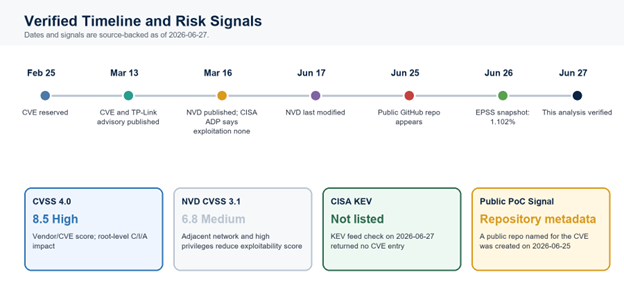
Figure 2. Verified disclosure timeline and risk signals as of 2026-06-27.
TP-Link/CVE scoring lists CVSS 4.0 as 8.5 High with vector AV:A/AC:L/AT:N/PR:H/UI:N/VC:H/VI:H/VA:H. NVD also provides a CVSS 3.1 score of 6.8 Medium. The apparent difference is a scoring-framework effect: the exploitability preconditions reduce the v3.1 base score, while the v4.0 score still reflects severe confidentiality, integrity, and availability impact to the vulnerable device.
FIRST EPSS reported 0.011020000, or about 1.102%, with percentile 0.615540000 for 2026-06-26. EPSS is a probabilistic exploitation signal, not an impact measure. A low EPSS value should reduce panic, not patch priority, when the asset is internet-edge infrastructure and the exploitation result is root-level control.
The CISA Known Exploited Vulnerabilities feed did not return CVE-2026-3227 when checked on 2026-06-27, and CISA ADP enrichment in the CVE/NVD data marked exploitation as none on 2026-03-16. A separate public-risk signal exists: GitHub API metadata shows a public repository named for the CVE created on 2026-06-25 by the credited finder. That is enough to assume exploitation knowledge may spread, but it is not proof of active campaigns.
Current Campaign Assessment
Assessment No authoritative source used in this review confirms active in-the-wild exploitation or KEV listing as of 2026-06-27. The correct corporate wording is therefore: public exploit availability risk has increased, but active campaign claims should not be repeated unless independently sourced. |
For security teams, the absence of a confirmed campaign does not make this low priority. Consumer and small-office routers often have long patch windows, weak inventory visibility, and limited telemetry. Public proof-of-concept material, even when not weaponized at scale, tends to compress the time between disclosure and opportunistic testing.
Likely Defensive Scenarios
Scenario | How it becomes reachable | Defensive focus |
Compromised LAN endpoint | Malware or a user-controlled device on the same Wi-Fi/LAN reaches the router admin interface. | Endpoint hygiene, strong router admin password, management VLAN, firmware update. |
Credential reuse | A reused or shared router admin password gives an attacker the required high privilege. | Unique passwords, credential rotation, password manager, account offboarding. |
Remote management exposed | An admin interface intentionally or accidentally reachable from untrusted networks changes the exposure model. | Disable remote management, enforce source allowlists, monitor edge exposure continuously. |
Untrusted config backup | An operator imports a backup received from an untrusted source or copied from an unverified device. | Treat config backups as privileged artifacts; inspect before import and rebuild manually if suspicious. |
Table 2. Defensive threat scenarios; these are risk models, not evidence of campaigns.
Detection and Hunting Guidance
There are no verified IP addresses, domains, hashes, or malware-family indicators in the TP-Link, CVE, or NVD records reviewed for this blog. Detection should therefore focus on asset state, configuration drift, and router behavior rather than brittle external IOCs.
- Inventory affected hardware and firmware. Look specifically for TL-WR802N v4, TL-WR841N v14, and TL-WR840N v6 below the fixed version thresholds.
- Review router administration logs for configuration import or restore events, especially when paired with unexpected admin source addresses.
- Compare current router configuration against a known-good baseline. Pay attention to port-triggering, port-forwarding, DNS, DHCP, static route, remote management, and firewall settings.
- Monitor for the router initiating unexpected outbound connections, DNS changes that affect clients, or sudden exposure of internal services.
- Search centralized logs for management events outside maintenance windows. Adapt generic fields such as event.action=config_import or settings_restore to your own logging schema.
- If web management is exposed externally, review internet-facing exposure through attack-surface management and firewall policy, then disable or strictly limit access.
Example Hunt Logic
The following examples are intentionally schema-neutral. They are not exploit instructions; they show the kind of telemetry relationship a defender should look for.
Config import | device.vendor=”TP-Link” AND event.action IN (“config_import”,”settings_restore”) |
Unexpected admin source | device.role=”router” AND auth.user=”admin” AND src.ip NOT IN trusted_admin_subnets |
Post-change egress | src.ip=router_ip AND network.direction=”outbound” AND dest.ip NOT IN known_service_allowlist |
Incident Response Playbook
- Identify affected devices and record model, hardware version, firmware version, WAN exposure, and management access path.
- If compromise is suspected, disconnect or isolate the router from the WAN and preserve available logs and a copy of the current configuration for internal forensic review.
- Update to the latest official TP-Link firmware for the exact model and hardware version. Do not cross-flash firmware between hardware revisions.
- Factory reset when compromise is plausible, then rebuild critical configuration manually instead of importing an untrusted or unexplained backup.
- Rotate router admin credentials, Wi-Fi PSKs, ISP portal credentials if stored locally, and any credentials that may have crossed the affected network during the suspected window.
- Validate DNS, DHCP, firewall, NAT, port-forwarding, remote-management, VPN, and static-route settings after recovery.
- Increase monitoring for router-originated outbound traffic and unusual client DNS behavior for at least one business cycle after remediation.
Mitigation and Hardening
Priority | Action | Reason |
Immediate | Update affected firmware to the fixed version or later. | This is the vendor-supported remediation. |
Immediate | Disable remote management unless there is a documented business need. | The CVSS vector is adjacent, but exposed admin interfaces expand practical reachability. |
High | Use a strong, unique router admin password and rotate shared credentials. | The vulnerability requires high privileges; credential quality is a primary control. |
High | Restrict management access to a trusted admin VLAN or wired maintenance network. | Reduces the chance that a compromised client can reach the admin plane. |
Medium | Treat router backup files as sensitive administrative artifacts. | Imported configuration can affect privileged control-plane behavior. |
Medium | Replace unsupported or end-of-life routers. | Unsupported firmware turns known issues into permanent exposure. |
Table 4. Practical mitigation plan for corporate, SOHO, and branch-edge environments.
Controls Mapped to the Attack Chain
A useful way to operationalize CVE-2026-3227 is to map each stage of the chain to a control that either blocks the precondition, reduces reachability, or improves detection after a suspicious configuration event. The goal is not to build a perfect signature for one exploit file. It is to reduce the chance that any untrusted configuration path can become an administrative execution path.
Attack stage | Preventive control | Detection control | Priority |
Admin session | Unique admin password; remove shared credentials; restrict management network. | Alert on admin login from non-admin subnet or unusual device. | High |
Config import | Do not import untrusted backups; rebuild manually after suspected compromise. | Log and review restore/import activity, especially outside change windows. | High |
Port-trigger settings | Disable unused port-triggering features where possible; keep firmware current. | Compare port-trigger rules to known-good baselines. | Medium |
Root execution impact | Patch firmware; segment management plane; replace unsupported routers. | Watch for DNS, DHCP, NAT, firewall, and router-originated egress drift. | High |
Table 5. Practical controls mapped to the verified vulnerability chain.
Secure Design Lessons
Although most readers will consume this issue as a patch-management item, the vulnerability also illustrates several secure-engineering lessons for router vendors, firmware teams, and enterprise buyers evaluating edge devices. Configuration data should be treated as untrusted input even when it is uploaded by an administrator. Administrative intent is not the same as input safety.
- Use strict schema validation for imported configuration values. Port numbers, protocol names, and rule names should be constrained to expected formats before any downstream processing.
- Avoid shell invocation when structured APIs or direct system calls can apply router state. When a shell is unavoidable, pass arguments safely and reject unexpected syntax before execution.
- Run web-management and configuration-processing components with the least privilege that still lets them do their job. Root should be an exception, not a default assumption.
- Log configuration restore/import events with timestamp, source address, admin identity when available, and changed configuration category. Many router incidents become hard to investigate because the device records too little control-plane history.
- Expose firmware lifecycle status clearly. Buyers and administrators need to know whether a model still receives security updates before deciding to keep it in service.
Operational Verification Checklist
Check | Evidence to collect | Pass condition |
Model and hardware revision | Photo, asset record, or admin UI hardware-version field. | Not one of the affected branches, or confirmed affected branch with fixed firmware. |
Firmware version | Admin UI firmware string or exported inventory record. | At or above V4_260304, V14_260303, or V6_260304 as applicable. |
Remote management | WAN management setting and firewall rules. | Disabled, or restricted to documented trusted sources. |
Configuration drift | Comparison against approved baseline. | No unexpected port-trigger, port-forward, DNS, DHCP, route, or remote-management changes. |
Post-remediation monitoring | Network logs or router egress baseline. | No unexplained router-originated outbound traffic after patch/reset. |
Table 6. Verification checklist for security operations and IT owners.
Strengthen your Online Brand Protection strategy with advanced Dark Web Monitoring to identify brand impersonation, data leaks, and unauthorized activities across hidden networks.
MITRE ATT&CK Mapping
The mapping below is a defensive interpretation, not a vendor-provided ATT&CK statement. Some techniques are context-dependent because the CVE record describes the vulnerability, not a complete campaign.
Tactic | Technique | Defensive interpretation | Confidence |
Initial Access / Credential Access | T1078 Valid Accounts | High privileges are required; the attacker must obtain or use an admin session before import. | High |
Initial Access | T1190 Exploit Public-Facing Application | Applies only when the router admin interface is exposed to untrusted networks. The default CVSS vector is adjacent. | Conditional |
Execution | T1059 / T1059.004 Command and Scripting Interpreter: Unix Shell | The vulnerability results in OS command execution on Linux-based firmware. | High |
Privilege Escalation | T1068 Exploitation for Privilege Escalation | Context-dependent: the web admin role crosses into root OS command execution. | Medium |
Impact | Post-exploitation impact | Traffic redirection, DNS manipulation, service exposure, or device disruption are possible outcomes, but not specific IOCs. | Analytical |
Table 7. Context-aware ATT&CK mapping for defensive planning.
What Not to Overstate
- Do not call this unauthenticated RCE. The verified records require authenticated administrator privileges.
- Do not claim confirmed active exploitation unless a reliable source confirms it. Public repository metadata is a risk signal, not a campaign report.
- Do not apply the affected-version statement to every TP-Link router. The confirmed affected products are three model/hardware branches.
- Do not rely only on EPSS or KEV status. Router edge compromise has high operational consequence even when broad exploitation probability appears low.
Sources
- TP-Link Security Advisory for CVE-2026-3227: Open source
- org record: CVE-2026-3227: Open source
- NVD record: CVE-2026-3227: Open source
- NVD API 2.0 query used for CVSS and affected-version details: Open source
- FIRST EPSS API query for CVE-2026-3227: Open source
- CISA Known Exploited Vulnerabilities Catalog: Open source
- MITRE CWE-78: Open source
- MITRE ATT&CK T1078 Valid Accounts: Open source
- MITRE ATT&CK T1059.004 Unix Shell: Open source
MITRE ATT&CK T1190 Exploit Public-Facing Application: Open source
Conclusion
CVE-2026-3227 is a narrow but consequential router vulnerability: exploitation requires authenticated administrator access, yet the successful result is root-level command execution on the network edge. For defenders, the right response is not fear-based amplification. It is disciplined asset inventory, fast firmware updates, restricted management-plane access, careful handling of configuration backups, and monitoring for configuration drift.
The larger lesson is that router configuration files should be treated like privileged code-adjacent artifacts. Any feature that imports and applies device state can become an execution path if values cross into shell contexts without strict validation and safe command handling.
About us!
Foresiet is the pioneering force in digital security solutions, offering the first integrated Digital Risk Protection SaaS platform. With 24x7x365 dark web monitoring and proactive threat intelligence, Foresiet safeguards against data breaches and intellectual property theft. Our robust suite includes brand protection, takedown services, and supply chain assessment, enhancing your organization’s defense mechanisms. Attack surface management is a key component of our approach, ensuring comprehensive protection across all vulnerable points. Compliance is assured through adherence to ISO27001, NIST, GDPR, PCI, SOX, HIPAA, SAMA, CITC, and Third Party regulations. Additionally, our advanced antiphishing shield provides unparalleled protection against malicious emails. Trust Foresiet to empower your organization to navigate the digital landscape securely and confidently.
Latest
From the blog
The latest industry news, interviews, technologies, and resources.