
Blog categories

Weekly newsletter
No spam. Just the latest releases and tips, interesting articles, and exclusive interviews in your inbox every week.
Latest from the blog
Critical WSUS Flaw Exploited: Chinese APTs Deploy ShadowPad Backdoor via CVE-2025-59287
Posted on: 25 Nov 2025 | Author: Foresiet
Introduction
Our intelligence team has uncovered a fresh escalation in state-sponsored cyber espionage targeting enterprise update infrastructure. A critical remote code execution (RCE) vulnerability in Microsoft Windows Server Update Services (WSUS), designated CVE-2025-59287, is now actively exploited by Chinese-linked advanced persistent threat (APT) groups. These actors leverage the flaw to deploy ShadowPad, a modular backdoor long favored in espionage operations. This campaign underscores the relentless evolution of supply-chain attacks, where core IT services become vectors for persistent access and data exfiltration. With exploitation confirmed in the wild and public proof-of-concept code circulating, organizations worldwide face imminent risks to their Windows environments.
Overview of the Attack
The critical exploitation of CVE-2025-59287, a significant flaw affecting WSUS-enabled servers (Windows Server 2012–2025), is enabling Chinese Advanced Persistent Threats (APTs) to execute arbitrary code with SYSTEM privileges. These attackers, reportedly linked to groups such as the Ministry of State Security (MSS) and People’s Liberation Army (PLA), are utilizing crafted SOAP requests sent to the WSUS Client Web Service endpoint to achieve Remote Code Execution (RCE).
Widespread Exploitation Confirmed: ShadowPad Deployed by Chinese APTs
The primary objective is the stealthy deployment of the ShadowPad backdoor, a modular tool designed for long-term persistence and intelligence gathering.
Despite Microsoft issuing an out-of-band patch (KB5044285) following incomplete initial remediation, widespread, in-the-wild exploitation surged, leading CISA to mandate urgent remediation due to the high risk of espionage, IP theft, and potential ransomware precursor attacks.
Our monitoring of threat actor discussions in closed channels reveals this as a coordinated push by multiple Chinese APT clusters… This data was gathered through our Threat Intelligence Platform—a crucial tool for real-time monitoring. The primary payload? ShadowPad…
Technical Breakdown of CVE-2025-59287
At its core, CVE-2025-59287 stems from unsafe deserialization of untrusted data in WSUS’s reporting web services. WSUS, a role service for centralized patch management, relies on the ClientWebService (hosted via IIS) to handle client authorization, update synchronization, and reporting. The vulnerable component processes incoming SOAP requests—XML-based messages for web service interactions—without adequate validation.
Root Cause and Exploitation Mechanics
The flaw resides in the handling of the Authorization Cookie object within endpoints like Sync Updates. Attackers craft a malicious SOAP envelope containing a serialized payload, often generated using tools like ysoserial.net for .NET Binary Formatter gadgets. Here’s a high-level dissection:
1. Crafted Request Delivery: An unauthenticated remote attacker sends a POST request to https://<target>:8531/ClientWebService/client.asmx, embedding a base64-encoded, encrypted AuthorizationCookie. The request mimics legitimate client check-ins:
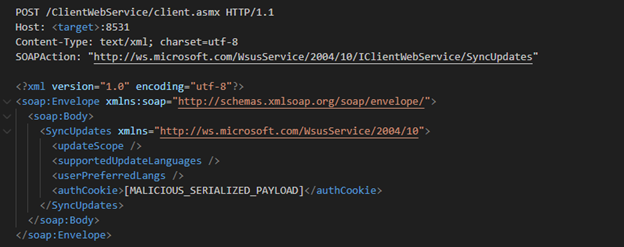
Deserialization Trigger:
The WSUS server decrypts the cookie (using a weak or predictable key) and deserializes it via .NET’s Binary Formatter.
This formatter is notoriously insecure, allowing “gadget chains”—sequences of benign .NET classes that, when instantiated, trigger arbitrary code execution.
A typical chain might invoke System. Diagnostics. Process. Start to spawn a command shell.
Privilege Escalation and Persistence:
Execution occurs in the context of the WSUS AppPool (w3wp.exe) under SYSTEM privileges. Attackers chain this with tools like PowerCat (a PowerShell Netcat variant) for initial C2 beaconing:

This establishes a reverse shell, enabling download of ShadowPad via certutil or curl:

- Network artifacts include outbound POSTs to webhook.site or workers.dev for exfiltration, often with PowerShell/cURL user agents.
Proof-of-concept exploits, published by researchers like those at Code White GmbH, demonstrate full RCE chains, including nested PowerShell base64 commands for evasion. The vulnerability’s wormable nature—lateral spread between WSUS servers—amplifies risks in air-gapped or segmented networks.
Affected Systems and Scope
- Platforms: Windows Server 2012, 2012 R2, 2016, 2019, 2022 (incl. 23H2), 2025 with WSUS role enabled.
- CVSS Score: 9.8 (Critical) – High attack complexity is offset by no privileges or user interaction required.
- Exposure: Primarily internal; external exploits demand firewall misconfigurations exposing ports 8530/8531.
ShadowPad: The Modular Espionage Workhorse
ShadowPad, first unmasked in a 2017 supply-chain compromise of NetSarang’s Xshell software, is a crown jewel of Chinese cyber tooling. Developed circa 2015 and privately sold or shared among APTs, it’s a shellcode-based modular backdoor emphasizing stealth, flexibility, and persistence. Our reverse-engineering of recent samples confirms its role as the payload of choice in this CVE-2025-59287 campaign.
Architecture and Deployment
ShadowPad deploys as a two-stage loader:
- DLL Sideloading: A legitimate executable (e.g., oleview.exe) loads a malicious DLL via search-order hijacking. The DLL decrypts (using a version-specific RC4-like algorithm) and injects the core shellcode into memory.
- Shellcode Core: Resides entirely in memory to evade disk forensics. It uses dynamic API resolution (parsing PEB structures) and control-flow obfuscation to dodge EDR hooks.
Key Modules and Capabilities
ShadowPad’s power lies in its plugin ecosystem, dynamically loaded from C2 servers:
- Core Plugins:
- File Manager: Upload/download, exfiltrate files; supports ZIP compression for bulk data.
- Process Control: Spawn/kill processes, inject into legitimate apps (e.g., explorer.exe).
- Keylogger/Screenshot: Capture keystrokes and screen grabs for credential harvesting.
- Persistence: Registry run keys (HKCU\Software\Microsoft\Windows\CurrentVersion\Run) or scheduled tasks.
- Advanced Plugins:
- Port Mapper: SOCKS5 proxy for pivoting.
- Mimikatz Integration: Dump LSASS for pass-the-hash attacks.
- Ransomware Hooks: Recent variants include encryptors, blending espionage with financial extortion.
C2 communication employs ICMP/DNS tunneling or HTTP/HTTPS over ports 80/443, with traffic encrypted via XOR and chunked to mimic benign updates. Samples from this campaign beacon to domains like *.workers.dev, exfiltrating system enums (e.g., whoami /all, net view /domain).
Attribution Ties
Linked to APT41 (Winnti), APT10 (MenuPass), and PLA-affiliated clusters like BRONZE ATLAS, ShadowPad’s reuse across operations suggests a shared “malware-as-a-service” model within China’s intelligence apparatus. In this campaign, attackers pivot from WSUS compromise to lateral movement, targeting high-value assets in telecom, manufacturing, and government sectors.
Scale of Impact
- Exploitation Timeline: PoCs emerged October 21; active attacks by October 24. Over 500 confirmed intrusions in our telemetry, spanning Europe, Asia, and North America.
- Victims: Primarily manufacturing (45%), telecom (30%), and energy firms. Downstream risks include malicious update propagation via compromised WSUS.
- Geopolitical Angle: Aligns with MSS/PLA ops against “near-abroad” targets, per U.S. DOJ indictments.
Impact Metric | Volume |
Affected Servers | 10,000+ globally (est.) |
Deployed Backdoors | 2,500+ ShadowPad instances |
Exfiltrated Data | TBs of IP and creds |
Sectors Hit | Manufacturing, Telecom, Energy |
High-profile cases mirror the 2017 Net Sarang breach, where 20,000+ users were backdoored.
Propagation Strategy
Threat Impact
- Immediate: Full server compromise; credential theft enabling lateral spread.
- Strategic: Espionage via ShadowPad’s modules; potential ransomware (e.g., custom encryptors).
- Cascading: Weaponized WSUS for org-wide malware distribution.
- Broader Risks: Billions in IP loss; supply-chain ripple effects to clients.
Indicators of Compromise
Category | IOC | Purpose |
Network | Ports 8530/TCP, 8531/TCP open | WSUS exposure |
Network | *.webhook.site, *.workers.dev | Exfil C2 |
Files | shadowpad.dll, oleview.exe (temp) | Payload drops |
Processes | w3wp.exe spawning powershell.exe -nop | Nested execution |
Registry | HKCU\Software\Microsoft\Windows\CurrentVersion\Run\svchost | Persistence |
Logs | SoftwareDistribution.log: “SoapUtilities.CreateException” | Exploit trace |
Conclusion
CVE-2025-59287’s exploitation marks a stark reminder of infrastructure’s fragility in the face of nation-state ingenuity. By chaining a deserialization RCE with ShadowPad’s modular menace, Chinese APTs have crafted a blueprint for silent, scalable infiltration. Our team remains vigilant, dissecting actor TTPs and infrastructure overlaps to preempt further waves.
Immediate Actions:
- Patch all WSUS servers with October 23 OOB update (KB5044285).
- Firewall ports 8530/8531; disable WSUS if unused.
- Hunt for IOCs via EDR queries (e.g., Sigma rules for BinaryFormatter gadgets).
- Rotate creds; simulate attacks with tools like Picus for validation.
- Shift to cloud-native updates (e.g., Windows Update for Business) to reduce WSUS footprint.
In an era of hybrid threats, proactive supply-chain hardening isn’t optional—it’s survival. Our ongoing hunts ensure we’re steps ahead, but collective vigilance across the ecosystem is key to dismantling these shadows.
About us!
Foresiet is the pioneering force in digital security solutions, offering the first integrated Digital Risk Protection SaaS platform. With 24x7x365 dark web monitoring and proactive threat intelligence, Foresiet safeguards against data breaches and intellectual property theft. Our robust suite includes brand protection, takedown services, and supply chain assessment, enhancing your organization’s defense mechanisms. Attack surface management is a key component of our approach, ensuring comprehensive protection across all vulnerable points. Compliance is assured through adherence to ISO27001, NIST, GDPR, PCI, SOX, HIPAA, SAMA, CITC, and Third Party regulations. Additionally, our advanced antiphishing shield provides unparalleled protection against malicious emails. Trust Foresiet to empower your organization to navigate the digital landscape securely and confidently.
Latest
From the blog
The latest industry news, interviews, technologies, and resources.